Requiems For The Departed is as Irish as a broken heart, yet universal in appeal. Stuart Neville’s “Queen of the Hill” alone is worth the price of admission, but it’s only the cream at the top of the pint. With stories from the likes of Bruen, McKinty, Moore, and Grant, you’ll want to squeeze every last drop out of this glass.
Reed Farrel Coleman three-time Shamus Award winner and author of Innocent Monster
Monday, 29 March 2010
Reed Farrel Coleman -- a man of exquisite taste...
Tuesday, 4 August 2009
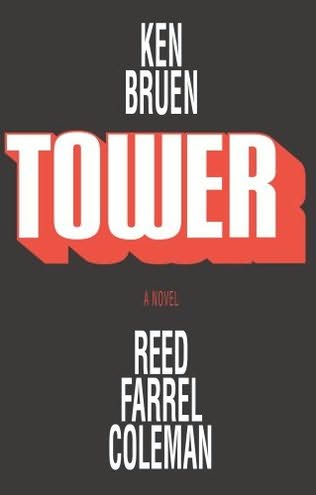
A Wee Review - Tower by Ken Bruen and Reed Farrel Coleman
I’ve read Walking the Perfect Square by Reed Farrel Coleman and a number of novels by Ken Bruen this year. When I heard that these two accomplished writers were collaborating on a novel I was excited. But to be honest, I was a little dubious too. Their styles are so completely different that I couldn’t visualise a way to package them together in a neat little novel that would do both writers the justice they deserve. No doubt I wasn’t the only person to hold this opinion, and I’m sure others with louder voices than mine were quick to voice it. But I have to say, I’m glad Ken Bruen and Reed Farrel Coleman decided not to listen to anybody but each other (and at a later date Allan Guthrie as editor) on this one.
TOWER is a collaboration novel in a much different mould than the trilogy Ken Bruen wrote with Jason Starr, now available from Hard Case Crime. With the HCC novels, the style is constant and you’d be hard pressed to figure out which writer delivered which line. And that’s cool, because in my opinion, that works. BUT the approach Ken Bruen took with Reed Farrel Coleman, though different, also works. You could almost say it’s two novellas that retell the same story in two different POVs, but that doesn’t do any justice to the efforts of either writer here. This short, sharp heartbreaker was years in the making, and it shows.
TOWER tells the tale of Nick and Todd, two childhood buddies from the tough streets of Brooklyn whose forays into crime drive a wedge between them. In their adulthood, they each take a different path that crosses over until they eventually meet one last time for an explosive conclusion to their journeys. And along the way, that word that raises the bile and strikes fear into the New York criminal underbelly – rat – throws everything they’ve ever known or thought about each other into disarray.
Nick’s perspective is written by Bruen and Todd’s by Farrel Coleman. There is a distinction in voice and style, but the writers make this work as a distinction in the characters’ inner dialogues and all-round make-up. The genius in this collaboration lies in the things that each writer hasn’t implicitly said, but that the reader is more than able to glean from the subtext and by cross-referencing the thoughts of the two protagonists. I’m lucky to have read this one ahead of its release date.
If you want a flat, plot-driven piece of s—s—summer reading, then this isn’t the book for you. And in any case, it’s not released by Busted Flush Press until September. However, if you want a read that’ll make you feel like you’ve had your heart scooped out (in a good way, like); you better get your hands on TOWER.
Saturday, 18 July 2009
Ken Bruen’s Writing Evolution

I received Tower by Ken Bruen and Reed Farrel Coleman recently (courtesy of Busted Flush Press). Since then, I’ve been thinking... I’ve read a fair number of Ken Bruen novels this year, both new and old, and I’ve found it a very interesting experience.
Thanks to Busted Flush Press you can read some of Bruen’s earliest work in a collection of novellas and short stories they’ve released titled A Fifth of Bruen. I read the opening piece in the collection not long after reading The Guards. Funeral: Tales of Irish Morbidities, as pointed out in the introduction by Allan Guthrie, is not a crime story, but the protagonist is almost an early version of Jack Taylor. Drunk, surly and difficult to get on with, but with a soul that springs deepest sympathy at the most surprising moments. And even with a cluttered mind like mine, you’ll spot a scene that has made its way into both texts. Some people might think of this as recycling. I prefer to think of it in fanboy terms -- like the books share a little overlap in the space-time continuum or something. Both Jack Taylor and Dillon, the protagonist from Funeral, visit a sick wino on his deathbed bearing the gift of socks. It’s a nice scene, brimming with righteous indignation and grief, and it adds a lot to the multidimensional characters from each story.
Another book that can be linked to The Guards via this space-time continuum thing is Dispatching Baudelaire. Mike Shaw, the turbulent accountant who provides the narrative for Dispatching Baudelaire, hints at a rocky relationship with his mother. Just like Jack Taylor. And both characters blame their mothers for the early death of their fathers. And both of their fathers had ten identical suits... Dispatching Baudelaire is a very different book than The Guards. The former is of a quirky American Psycho or Dexter mould whereas the latter is a hard-as-nails PI tale. But the little snippet of back-story works equally well in both novels.
Jack Taylor may be Bruen’s most popular character, but I think his genesis is an interesting one. If you haven’t read his early work, I’d say it’s definitely worth seeking out. It’s not too hard to find. Just look here. As well as the nerdy rush to be had at spotting space-time continuum overlaps (or recycled scenes), the reader will find that Bruen’s idiosyncratic way with prose has been constant (though refined) throughout the years. And let’s face it, the speed most of his fans burn through one of his novels? It’s good to know there’s a little more out there to keep you going until his next release.
Thursday, 26 February 2009
Fancy a Link?
Monday, 16 February 2009
A Wee Review - Walking The Perfect Square by Reed Farrel Coleman
I’ve very recently been introduced to Moe Prager, Reed Farrel Coleman’s Brooklyn PI. It was a far from unpleasant experience. In fact, (and I can’t believe I’m falling back on such an obvious cliché) Moe’s the kind of guy I could chat to over a few beers, I reckon. And I believe that’s what Farrel Coleman wanted to achieve in creating this well-layered nice-guy protagonist.
Walking The Perfect Square is a missing person mystery set in Brooklyn, New York. Retired beat cop, Moe, is enlisted as a last long shot in finding a young man, whose father is a rich and powerful politico. Moe has no real desire to take on a private investigation, but a sense of loyalty to an old colleague and a highly believable love interest soon sways him. This is another slow-revealer that would be spoiled by too much plot inspection, but you have my word that the story is always moving and gripping.
The book isn’t quite action-packed, but then Moe isn’t an action man. He’s a thinker. And as such, the few scenes of violence carry a lot of impact. Like many crime fiction fans, I like a lot of hard-boiled writers who write good violence, but I think there’s plenty to be said for how Farrel Coleman deals with it in Walking The Perfect Square. It’s the threat of violence that creates the tension, and that can be quite a difficult thing to pull off. This is the work of a writer who doesn’t take the easy way out.
Walking The Perfect Square is also a nice insight into Brooklyn, a place Farrel Coleman obviously has much love for. As Adrian McKinty joked in a comment to an earlier post on this blog, Brooklyn people love to tell you they’re from Brooklyn. Moe Prager does that too. And when he uses his contacts to pull in favours and information, you get an idea that a person can really feel like they belong on those streets.
In Walking The Perfect Square, Farrel Coleman takes the classic PI formula, updates it and gives it a little more humanity. Moe Prager is aware of his limits and has the good sense to try and stay within them as far as he can. It’s just the situations he finds himself in that put him in danger. This is how real people act and I like reading about real people. So call me a Reed Farrel Coleman fan.
I’ll be looking forward to the rest of the Prager novels, three of which can be bought from David Thompson’s Busted Flush Press. But I’ll be especially interested in what Reed Farrel Coleman and Ken Bruen have created in their collaboration project, Tower, which will be published by Busted Flush this year. Both writers employ very different styles in their writing, but I’m sure they’ve found a happy medium between them. Should be a very interesting result.
Thursday, 29 January 2009
An Interview - Reed Farrel Coleman

Q1. What are you writing at the minute?
That would be telling! Sorry. I’m about 110 pages into the first novel in a new series. It features a protagonist who is a psychologist, but who suffered a mental breakdown and lived hard on the streets for several years. He’s put his pieces mostly back together again and returns home to New York for the final act in his recreation. That final act revolves around the attempted solution of a long forgoten crime. He has quite a unique perspective on things and a really strange skill set.
Q2. Can you give us an idea of Reed Farrel Coleman’s typical up-to-the-armpits-in-ideas-and-time writing day?
Sure. First, you’re not far off on the ideas thing. I am positively flooded with ideas for books. I’ve often said that I could not live long enough to write the books I get ideas for in a single day. It’s funny how readers think the ideas are the difficult part. But basically, I get up around 7 AM, drink two cups of coffee while reading the local rag—sports first—and doing the crossword. Then it’s down to my home office to answer emails. By about 8, I put in three straight hours. I start with rereading the previous five pages to give myself a running start and momentum. I need that as I never outline and it helps me edit edit edit. I’ve only ever produced one draft of a novel, but by the time it’s done, I’ve reread it a hundred times and edited it to within an inch of its life. I’ll usually take a break and come back an edit some more, add a little bit, edit. The bulk of the work gets done in that early rush and the rest of the time throughout the day is devoted to polishing. Still, I write pretty quickly. My last novel, The Fourth Victim, written as Tony Spinosa, took only 3 months from start to finish.
Q3. What do you do when you’re not writing?
In warm weather, I play basketball for about two hours a day five days a week. I love the movies and go quite often with my sixteen year old son. I read less than I wish I could. I do all the cooking in the house as well.
Q4. Any advice for a greenhorn trying to break into the crime fiction scene?
Sit your ass down and write. I find too many of my students and hopefuls spend way too much time worrying about marketing and agents and dreaming about spending their advances. It’s what’s on the page that counts. The rest is an issue of control. But you have to learn the writing is the only part you can ever really control, so focus on that. The most important advice I can give is that a writer should fall in love with writing and not with what he or she has written. The latter is a major roadblock to success.
Q5. Which crime writers have impressed you this year?
Besides the usual suspects like Ken Bruen, SJ Rozan, Megan Abbott, Daniel Woodrell and the like, I discovered that I like Archer Mayor a lot and Gabriel Cohen has come back very strong. I liked Declan Burke and Christa Faust very much.
Q6. What are you reading right now?
I’m reading an ARC of Megan Abbott’s next book, Bury Me Deep. And I just finished James Crumley’s The Last Good Kiss.
Q7. Plans for the future?
Plans is too strong a word for a writer. I will always write and I’ve got some projects in mind. I have at least one more Moe Prager book in me for which I have an idea. I’ve been working on a meta book for two years now in my spare time and have a sci-fi book that I want to finish.
Q8. With regards to your writing career to date, would you do anything differently?
I’m not a regretter. So while there are things that I might do differently had I the chance, I don’t waste a second rueing my missteps or mistakes.
Q9. Do you fancy sharing your worst writing experience?
The list is so long... I’m joking, really. Let me think. See I don’t perseverate on the bad stuff. Okay. I turned in a novel to my editor and he or she was terribly frightened by the subject matter and many of the motivations I had for my characters acting in the way they did. My agent was quick to jump on my editor’s bandwagon and they both sort of forced me into making changes in the book I shouldn’t have made. What I got was a good enough product, but not the book I wanted. The book didn’t do well and I think some of that is because it wasn’t the book I originally wrote. It was largely ignored by critics and readers. To go back to the previous question, I think I should have pulled the book.
Q10. Anything you want to say that I haven’t asked you about?
I always find that to be the most difficult question of all. I guess I’d like you to ask about Tower, the novel I co-authored with Ken Bruen. It was the most difficult work I ever did and the best I ever did. When it comes out in September from Busted Flush Press here in the States, I would highly recommend it as a pretty unique reading experience.
Wednesday, 28 January 2009
London Boulevard's Hollywood Treatment

So, in the words of Apu Nahasapeemapetilon, "Thank you, come again."
Friday, 5 December 2008
Another Collaboration Bruen (Brewin’ geddit? No? Dec Burke’s much better at these pun things, and he knew about this before me, mutter-mutter...)
Talk about prolific.
And who’s he teaming up with? Why don’t I let David Thompson of Busted Flush Press field that one?
“Coming fall 2009, Tower marks the first collaboration between crime writers Ken Bruen (The Guards, Once Were Cops) and Reed Farrel Coleman (The James Deans, The Fourth Victim), and the first original novel published by Busted Flush Press. With four Shamus Awards and four Edgar Award nominations (and plenty of other trophies!) between them, Bruen and Coleman combine forces with a novel that is steeped in metaphysics, baseball, and brutality...”
And how about a little bit about the book, David? Something blurb-like, maybe?
"Born into a rough Brooklyn neighborhood, outsiders in their own families, Nick and Todd forge a lifelong bond that persists in the face of crushing loss, blood, and betrayal. Low-level wiseguys with little ambition and even less of a future, the friends become major players in the potential destruction of an international crime syndicate that stretches from the cargo area at Kennedy Airport to the streets of New York, Belfast, and Boston to the alleyways of Mexican border towns. Their paths are littered with the bodies of undercover cops, snitches, lovers, and stone-cold killers.”
That sounds brilliant, man.
But I have to wait so frickin’ long. What’ll I do until then?
Well, thanks to David’s Busted Flush Press, I’ll soon be enjoying Reed Farrel Coleman’s Walking The Perfect Square and Ken Bruen’s A Fifth of Bruen. I’ll be sure to let you know what I think.
Pop on over to Busted Flush and see what else they have to offer.
Oh, one more thing. Call it a cherry on top, or a belt of scotch. Allan Guthrie, Scotland's Noir Original, is feckin' editing Tower! A triumvirate of talent I tell you.