Tuesday, 9 June 2009

A Wee Review - Gutted by Tony Black


I read Tony Black’s Gutted amid a binge of Allan Guthrie novels. Both writers are Edinburgh based and both set their novels in and around Leith. Their work is very different in style and tone, but it’s undeniable that they each possess a huge talent for writing. Black has received high praise from Ken Bruen, and the protagonist of Gutted, Gus Dury, is reminiscent of Bruen’s recurring character, Jack Taylor. But again, differences in style and tone set the two characters apart. Dury is not the poor man’s Taylor. He’s a devastated and tragic hero whose strong moral compass is sometimes clouded by the ‘scoosh’ (cheap scotch).

From the opening sentences we immediately get the measure of Gus Dury. He hears screams in the woods and although he knows it’s a stupid thing to do, he hurls himself directly at the source. And when he discovers a bunch of youths torturing a dog tied to a tree, he lets rip on them, outnumbered or not. Unfortunately, he literally stumbles upon something downright gruesome during the scuffle. And being the man that he is, he allows the discovery to suck him in to an investigation that’ll fair put him through his paces.

Black brilliantly captures the damaged mind of a man who can’t see a life for himself without drink. Dury was once a great investigative journalist with a wife and a good life. But, as is so often the case, alcohol, that demanding mistress, stripped him of everything but a bar he inherited from a late friend. Yeah, an alcoholic with his own bar. Couldn’t be healthy. But his contacts from his former life are still at his disposal, all be it unwillingly in most cases. And so, he’s become something of a private investigator. But he’s more than that. He’s also a drunken social commentator. Dury is exasperated by the modern world of celebrity worship, trendy bars and reality TV. The fury of Dury is let loose more than once in Gutted and he rants his pants off on just about any topic he can think of. And if you’re not careful, you’ll find yourself nodding along to this grizzled nutter’s diatribes.

Black has rejuvenated the often imitated drunken PI in his work. He’s also rejuvenated an interest in Edinburgh that I first worked up while reading Irvine Welsh’s work. We get an inner city tour as Dury travels the street in ‘jo-baxis’ (taxis), buses and on foot. And reconnecting with wonderful Leith slang-words like jakey, chibbing and schemie was a real treat. And in reading the slang and enjoying the moments of black humour, it struck me again and again how closely tied the Scottish are to the Northern Irish. I look forward to more work from this guy and his Scottish contemporaries.

You want something even more refreshing than a pint or two of the black stuff? Then give Tony Black’s stuff ago. And the morning after, your head will be clearer and you won’t smell as bad either.

Gutted will be released in June 2009.

Monday, 8 June 2009

A Wee Review - The Twelve by Stuart Neville


Stuart Neville is of a new generation of writer. He cut his teeth on the internet through short story sales to small press publications, and is the perfect example of a writer who’s taken note of all the advice out there for the literary minded. He honed his craft through online critiquing and the internet played a big role in his road to publication. Cherry-picked by super-agent Nat Sobel after his short story featured on ThugLit, an online magazine, his literary profile has rocketed over the last year and it seems that the sky’s the limit for this budding writing career.

Neville’s debut, The Twelve, is a blistering Belfast-set thriller. The narrative centres on the actions of Gerry Fegan, a Republican hitman put out to pasture in the new Northern Irish political climate. But Fegan’s past has come back to haunt him, in the form of twelve ghosts, and they’ve driven him towards a bloody road to redemption.

The Twelve is marketed as a thriller, though there are crime, noir and horror elements in this genre straddling novel. The reader can’t be sure if the twelve ghosts are real or only exist in the protagonist’s mind, but they create a creepiness that pervades the story. Neville accomplished the difficult task of making a brutal killer a sympathetic character. Fegan’s guilt and the resulting alcoholism contradict his reputation as a cold-hearted assassin somewhat, and this softens the reader a little. But it’s not until the realistic love interest enters the equation that we really get to see, and begin to like, Fegan.

The novel’s antagonist, Campbell, is a very interesting character too. Really, by traditional values, he should be the good guy. His task is to end Fegan’s rampage before it destroys the peace process and cripples Stormont. And yet, I didn’t really like the sneaky fecker for most of the novel. But where Neville exercises his writing skill once again, is in making the reader care about Campbell, even if he is a git.

Paramilitaries, ex-paramilitaries, politicians and all the mixes in between are drawn perfectly and act and speak authentically in The Twelve. And I think Neville achieves this with the right balance of contempt and respect. There is no mistaking Neville’s feelings for the Troubles in reading this book, but his personal politics are not shoved in your face. He stays true to the story and the characters, and for that, Stuart Neville deserves serious kudos.

I predict The Twelve will launch Neville’s career -- that’s a no-brainer. But as excellent as it is, I’m dying to read his next one because I reckon he’ll raise the bar (no pressure, like). Just another year to go, I suppose. A top class effort from a top class writer. Essential reading for anybody who wants to get to grips with the new Northern Ireland. Be sure to grab a copy when it hits the shelves in early July. Oh, and if you’re an American reader, you should look out for the same novel under the title The Ghosts of Belfast in a few months time.

Saturday, 6 June 2009

Just Back

Been in Galway for a week without internet access, or even a computer. Just enjoyed my family, the weather, good food, some beer and some reading.

Read:

War of the Blue Roses by Garbhan Downey
Dispatching Baudelaire by Ken Bruen
The Killing of the Tinkers by Ken Bruen

And I started Slammer by Allan Guthrie.

Brilliant time!

I've emails and blogs to catch up on. After that, normal service? I hope.

Wednesday, 27 May 2009

Upcoming No Alibis Event


FRI 26TH JUNE 7PM

FREE..BUT LIMITED SPACE, SO PLEASE CALL IN FOR A TICKET

LAUNCH PARTY AND GENERAL KNEES UP TO CELEBRATE THE LAUNCH OF TWO NEW NOVELS, ONE FROM AN ESTABLISHED INTERNATIONAL AUTHOR THE OTHER BY AN UP AND COMING LITERARY THRILLER WRITER…..WHO MANAGED TO GET JAMES ELLROY TO BLURB HIM!!!!

NO ALIBIS BOOKSTORE
83 BOTANIC AVENUE
BELFAST BT7 1JL
david@noalibis.com
ph. 02890-319601
fax. 02890319607

Sunday, 24 May 2009

Savouring Chandler


A couple of weeks ago I shocked the blogosphere by admitting a huge deficit in my crime fiction reading. Well, maybe not the blogosphere. More like five people, I'd estimate, but I'm a fan of hyperbole.

Anyway, Penguin's imprint, Hamish Hamilton, stepped in to help me out by sending five GORGEOUS Raymond Chandler books. I'm halfway through the Big Sleep right now and feel compelled to blog a little about a line or three I read today.

"... but a pansy has no iron in his bones, whatever he looks like."

"He was like Caesar, a husband to women and a wife to men."

"Go -- yourself."


It struck me as an interesting sign of the times. Chandler didn't drop the F-bomb in The Big Sleep, yet he had no problem with Marlowe's sweeping statements about pansies and using another deeply offensive and homophobic F-word. And it made me wonder, fifty years from now, what will readers of the future classics (I'm thinking Bruen, McKinty, Bateman, McGilloway and all my favourites) pick out as bizarre and dated?


Friday, 22 May 2009

Newsflash! Movie Bruen... Once Were Cops


I read and loved Once Were Cops by Ken Bruen. You can read my thoughts on the deliciously dark novel in my CSNI review. So, it makes me smile on this pleasant Friday afternoon to relay some interesting news. It looks like it'll be the next Ken Bruen novel to receive the Hollywood treatment.

Who'd you like to see as the cop protagonists? I'm punting for Colin Farrell as Shea and Brendan Gleeson as Kebar. Bring back the In Bruges duo, I say!

An Interview - Rob Kitchin


Rob Kitchin: The day job is running a research institute. I spend most of my time either in meetings or writing funding applications, academic papers or books. After a few false starts, The Rule Book, my first novel, was published on May 16th. Hopefully in time it’ll open up a new horizon and I can at least give up the meetings.

My one and only review to date is by Joe Duffy from RTE who stated: "One of the most unusual crime novels to come out of Ireland in recent times. A gripping thriller with characters that ring true coupled with images and acts that would leave even Hannibal Lecter silent! There are more twists than the red cow roundabout, but you will not lose the plot in this clever and unusual crime novel." Perhaps a few more of those and the horizon might start to transform.

Q1. What are you writing at the minute?

On the novel front I’m writing the third book in McEvoy series. The working title is ‘In the Bog’ and it has Det. Supt. McEvoy trying to solve the murders of two women, killed forty years apart, both discovered within days of each other in Leitrim bog. I’m about halfway through at present. On the academic front, I’m trying to finish off a book on the embedding of software in everyday life, plus a couple of reports.

Q2. Can you give us an idea of Rob Kitchin’s typical up-to-the-armpits-in-ideas-and-time writing day?

I spent a fair few hours writing every day, whether its dozens of emails or reports, papers or chapters. Any novel writing is reserved for the evening and weekends. I haven’t done anywhere near as much as I would have liked to in recent weeks. Ideas are never a problem, time is! Thankfully I don’t suffer from writer’s block, mainly I think, because I’m conditioned to grind out a couple of thousand words a day doing the day job. I suspect journalists are similarly disciplined which is why so many successfully transfer to novel writing.

Q3. What do you do when you’re not writing?

Read, walk the dogs, and slouch in front of the television killing time that could be spent more productively doing other things.

Q4. Any advice for a greenhorn trying to break into the crime fiction scene?

I am a greenhorn trying to break into crime fiction and I’m still fairly clueless at this stage. The only thing I can advise is keep plugging away and hope for the best.

Q5. Which crime writers have impressed you this year?

So far I’ve mostly been reading books by writers who I’ve read previously, filling in back catalogues – Alan Furst, Joe Lansdale, James Lee Burke, Peter Temple, Michael Connelly, Arnaldur Indridason, John Harvey, Graham Hurley, Philip Kerr – mainly because they made an impression with other books. I particularly enjoyed the latest Kerr novel, ‘A Quiet Flame’ – the whole Bernie Gunther series has been excellent. I think the only thing I’ve bought that has been published in 2009 is Gene Kerrigan’s ‘Dark Times in the City’ which is next on my to read pile. The plan is to spend the second half the year discovering new stuff. I’m always after a good recommendation.

Q6. What are you reading right now?

On the novel front I’m a few pages into Tana French’s ‘In the Woods’. On the non-fiction front, I’m halfway through ‘The Algeria Hotel: France, Memory and the Second World War’ by Adam Nossiter that examines how the French have dealt with the Vichy period and the complicity of that government in the holocaust.

Q7. Plans for the future?

To keep plugging away! I’ve the second book in the series complete and a couple of other drafts mostly in good shape. Hopefully they will translate into an alternative career of sorts in time. I’ve no ambitions to give up the day job but it would be nice to have options!

Q8. With regards to your writing career to date, would you do anything differently?

I’d have been much more proactive in seeking an agent/publisher for the various drafts I have rather than being discouraged after two or three form rejection letters. The process of getting academic and fiction writing published is completely different and I made the mistake of partially conflating the two.

Q9. Do you fancy sharing your worst writing experience?

A lot of my academic writing is co-written. I’ve written pieces with over 40 people at this stage and occasionally that can get a bit fraught, especially if people don’t do what they said or we can’t agree on an argument. I’ve never come to blows with anyone, but let’s just say there are a couple of them I’d be very reluctant to write with again!

Q10. Anything you want to say that I haven’t asked you about?

No, I don’t think so, other than to thank you for the opportunity to do this.

Thank you, Rob Kitchin!

Thursday, 21 May 2009

Stuart Neville Reviews Blood's a Rover by James Ellroy


James Ellroy finally brings us the conclusion to the American Underworld Trilogy, and his most personal novel since his 1987 breakout, THE BLACK DAHLIA. BLOOD'S A ROVER fulfils yet confounds every expectation.

The book takes its name from a line in the A.E. Housman poem, 'Reveille'. The imagery of the title implies the pervasive violence of Ellroy's world, but the wider theme of Housman's poem -- the brevity of life, and the imperative to live it well -- gives a better clue to the soul of the novel.

After a bloody prologue, the story-proper begins in 1968 by introducing Ellroy's triad of protagonists. Cop-turned-narco-chemist Wayne Tedrow Junior is back, older and more battle-hardened than when we last saw him in THE COLD SIX THOUSAND. FBI heavyweight Dwight Holly is promoted to centre stage as he works for and against a fading J. Edgar Hoover. New face Donald 'Crutch' Crutchfield, a young would-be private investigator, stumbles into the murk of Ellroy's American nightmare. We also have the all-star cast of historical figures that is a signature of the trilogy. There's Hoover in physical and mental decline, Howard Hughes at rock bottom, Richard Nixon on the ascendant, and any number of political and showbiz players of the time.

The plot is a classic Ellroy labyrinth: the Mob attempts to create a new Havana in the Dominican Republic; Hoover sets out to bring down the Black Power movement; a body in an abandoned house is connected to Haiti by a trail of hijacked emeralds. These seemingly disparate stories intertwine to form a dense, propulsive narrative that has one constant: Joan Klein, political agitator and object of obsession for all three protagonists.

So far, so Ellroy, you might think. Yes, all the Ellroy trademarks are present and accounted for. Dirty cops, dirtier politicians, brutal violence, booze, drugs, guns, it's all there. But what surprises the reader is that Ellroy takes everything we expect from him and turns it on its head. At first he comforts us with familiar structures and stylistic tics, then in one shocking revelation after another we realise nothing in this story can be taken on face value, not even the narrative itself. When he takes our expectations and uses them against us, it is the work of a master.

And here's the biggest revelation of all: forget everything you think you know about James Ellroy's politics. Those ugly facets of the macho persona he writes so well -- the racism, misogyny and homophobia -- might well have led you to believe Ellroy is so right-wing he makes George W. Bush look like a pinko. But if a novel can give an insight into a writer's true nature, then BLOOD'S A ROVER belies the author's carefully cultivated public image. Ellroy mercilessly examines the cost of fascism to society, and the terrible price the men who misuse power must pay for their crimes. That's not to say Ellroy has gone red on us; the far left is treated with equal disdain as his fictional ideologues prove to be as misguided and self-serving as their real-world counterparts. Taking in the overall arc of the trilogy, the true message becomes clear: those who abuse power to serve their own political and personal agendas will suffer for their sins, whether they lean to the left or the right.

The ferocious polemic of BLOOD'S A ROVER wouldn't have a fraction of its impact if not balanced by its surprising humanity. The character Don 'Crutch' Crutchfield is ostensibly based on a real-life private eye, but the depiction on the page is closer to Ellroy's own confessions of a misspent youth. Crutch is a voyeur who spies on women, tails them, and breaks into their homes. His private eye gig provides a means to scratch this itch. Ellroy has spoken openly about his early days and the unsavoury pastimes he indulged in. Crutch becomes an avatar for the author's younger self, revealing more of Ellroy than any fiction he's written since he confronted his own mother's brutal murder in THE BLACK DAHLIA.

The female characters in BLOOD'S A ROVER stand in contrast to those who populated his earlier works. They are more than objects of desire; they are not there simply to frustrate, entrap and betray the male protagonists. Their roles in the story carry more weight than we have ever seen from Ellroy in the past, particularly the Red Goddess Joan.

The meaning of Housman's poem, that man must not waste his life, begins to resonate as the protagonists strive for atonement against desperate odds. This emotional maturity gives BLOOD'S A ROVER a beating heart that arguably no other novel in James Ellroy's oeuvre has had before. And that heart is what makes it all so visceral, beautiful and horrific. BLOOD'S A ROVER is everything and nothing you wanted it to be, and the trilogy as a whole must be considered a landmark in American literature.

(M
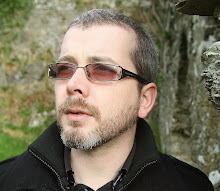
any thanks to Stuart Neville [picture above, right] for the CSNI contribution -- gb)

Wednesday, 20 May 2009

Blogspot Payback - Internet Noir


Although David Torrans came up with the title for this post, I don't think he'll mind me using it. You see, I'm writing to inform you that David has put his collection of first editions on the shelves at No Alibis. And what a collection! I knew this day was coming, but I decided to keep a lid on it until I could get to the shop and get my pick of the bunch. I found three books and paid a ridiculously low price... on the understanding that David would receive "Blogspot Payback." It's a nice little phrase, innit? Anyway, if you can, get thee to No Alibis! There's a tonne of great books just waiting to be snaffled.

So, what did I take home yesterday?

The Killing of the Tinkers by Ken Bruen (US signed first edition)


Dispatching Baudelaire by Ken Bruen (UK and Ireland first edition)


The Sad Case of Harpo Higgins by Eugene McEldowney (UK and Ireland first edition)


Oh, and I picked up one Peter Rozovsky at No Alibis as well. Removed him from the premises before the temptation of a smash and grab took hold of him. Calmed him with a trip to Dundrum Castle and some Chinese food. Not a bad day, it has to be said.

Monday, 18 May 2009

War of the Blue Roses - Coming Soon!

Since reading Yours Confidentially last year, I've been eagerly anticipating the next Garbhan Downey novel. Well, I'm currently reading an ARC of War of the Blue Roses. I'm on chapter 5 at the minute, and this could well be his finest work to date.

While I work my way through the book and procrastinate for the required amount of time before reviewing it, why don't you guys feast your eyes on this fantastic John McCloskey cover? McCloskey, besides being a double Celtic Film Festival gold torc-winner for animation is also the former guitarist with Derry punk legends Bam Bam and the Calling. And when you're done gawking at that, have a read through the Guildhall Press press release.


COMING SOON...COMING SOON...COMING SOON

‘War of the Blue Roses’

by Garbhan Downey


Who knew this flower-growing business could be so dangerous?

Guildhall Press are delighted to announce the release next month of ‘War of the Blue Roses’, the riotous new novel from Garbhan Downey.

‘War of the Blue Roses’ – the much-anticipated sequel to Downey’s widely-acclaimed comedy-thriller ‘Running Mates’ (2007) – is a rollicking black comedy set in the world of international politics.

In the book, a US sponsored gardening competition in the little country village of Mountrose ends up throwing three governments into turmoil when it sparks a worldwide race to grow the world’s first blue rose. The Irish premier is forced to team up with semi-reformed gangsters to stop British and American politicians shanghaiing the Mountrose Prize and walking off with a billion-dollar patent. Bugging, burglary, sabotage, murder and sexual deceit – it’s all part of the rose-growing business. And the bad guys are even worse…

‘Roses’ is Downey’s fifth novel and is set to enhance his reputation as a top-class writer. His last book, ‘Yours Confidentially: Letters of a would-be MP’, was listed by a number of reviewers on their ‘Book of the Year’ lists – and was one of the Philadelphia Inquirer’s seven International Crime Fiction ‘must-reads’ of 2008. Downey’s debut novel, ‘Private Diary of a Suspended MLA’, was described in the Sunday Times as “the best Northern Ireland political novel of the century”.

The cover of ‘Roses’ is designed by the award-winning animator John McCloskey, whose film ‘Crumblegiant’ was nominated for a BAFTA in 2008.

For further information about the author and details of his books, please visit: www.ghpress.com or www.garbhandowney.com