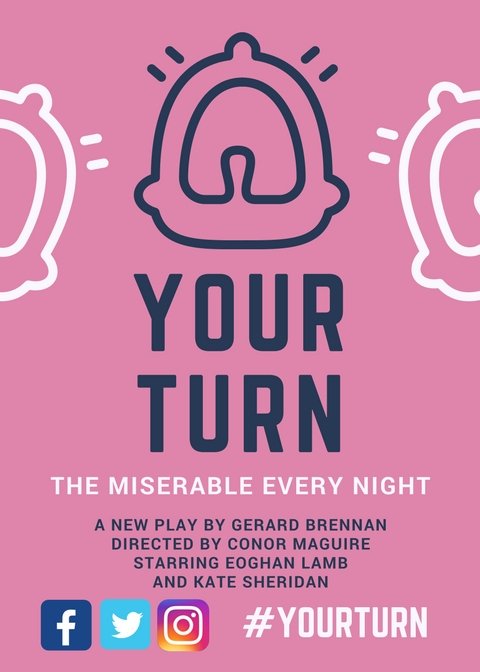
I'll be forever grateful to Conor Maguire for being so determined to get this play on the stage. And for finding the perfect actors to bring it to life. Come one, come all, and let's get this show on the road.
YOUR TURN
SUNFLOWER PUBLIC HOUSE
TUESDAY 8 & WEDNESDAY 9 MAY, 8.00PM
TICKETS £8.00 BOOK TICKETS
A riotous new comedy makes its premiere at the Cathedral Quarter Arts Festival this year. Every parent will know when it’s your turn, it’s your turn, except when it isn’t…
Relationships, stand-up, and how not to dispose of nappies all feature as a couple wake up to the reality of parenthood.
Penned by Gerard Brennan, who co-wrote The Sweety Bottle with his father, Joe, the first play to transfer from The Baby Grand to the main stage at The Grand Opera House.
Doors 7:45pm | Unreserved Seating
Tickets also available from: Visit Belfast | 028 90 246 609
9 Donegall Square North - Open 7 days a Week
Conor Maguire Presents… staged a reading of Troth by Rutherford Mayne on Tuesday 10th November in Castlereagh Civic Centre.
Troth is a powerful commentary on the complex web of loyalty and division that criss-crossed nineteenth century Ireland. An Ireland where ‘your place’ was an unsure, unsteady concept, where the reality of privation could bridge religious divides and where the Quality shared a religion with their tenants but spared them no sympathy.
Failing tenant farmer McKie has suffered too much – the loss of a son, the threatened loss of his farm – to take comfort in his illusory kinship with the distant, never seen Colonel Fotheringham. Unlike his labourer John Smith, who exhorts Mrs McKie to remember that Colonel Fotheringham and blames the ‘Moores and Maguires and Maguinnesses’ for the tenants plight. Smith’s defence of the Quality earns him a job up at the demense, but earns him rebukes and distrust from his master and mistress.
It is Moore, a Catholic tenant farmer in even worse straits than McKie, to whom McKie feels a connection. They are not insensible of the traditional tensions between them , it goes unsaid throughout the text there but there is a powerfully unstated stage direction that captures it – He starts up and reaches for he gun, then suddenly suspicious of MOORE, he stops and looks around at him - but in their shared suffering, with Moore’s ill-fortune not only matching but surpassing that of McKie, they find common ground. And it is to the language of that suffering that they return to again and again, shaping incitement and need for assurance around the reminders of the pain they had both gone through. Moore conjures the memory of hardship and death when he speaks to McKie: Then the sickness come and the wee children – they slippit away one by one. One was to be called after you, McKie of Ballhanlon, and two of my own wee childre…Now they are lying rotten under the sod and their wee souls are crying. You can hear them in the wind crying – crying to the God that made them for vengeance! And later when McKie seeks the surety of a sworn oath from Moore he again invokes their dead children: I want a promise of you, Francey Moore. We two have seen our wee children, as you say, slip beyont us, and we have seen the brown earth shovelled them the way you would bury a dog. They were buried the same day – my son and your own.’
Troth is a sere and unrelenting piece of work, brutal despite the lyric moments that escape into the dialogue, and well suited to Conor Maguire’s frugal staging. With only a stage and a few chairs the actors, under Maguire’s direction, captured not only their characters but their surroundings. When Paul Kennedy reached for Mr McKie’s gun and hesitated, you could practically see the metal of it. And when Jo Donnelly, whose portrayal of the reeling Mrs McKie was perfection itself, held herself and threw her head back, wild eyed, to listen to the corpse pass by…you felt the chill.
Faolán Morgan who played Moore was less instantly impressive. His entrance as the shaken, grieving Moore, fresh from his wife’s death bed, was muted, but as he rose to his feet to deliver Moore’s crow-harsh indictment of the landlord he was riveting. Each word was pitch perfect, whether it was intended to convey contempt, anger or grief. Nor should Mark Claney as John Smith go unmentioned. In a play full of tension and high emotion his character had the least to work with, yet he was perfect as the good-natured but ultimately untrustworthy Smith. The eager suspicion in his voice as he demanded ‘Did the Master go out with Moore next the Glen?’ fed perfectly into Donnelly’s carefully controlled terror.
It was a powerful performance of a powerful play, with Conor Maguire hitting his stride as director to orchestrate an almost perfect production. With only one more Rehearsed Reading left for the programme – on the Tues 8th December – I look forward to seeing how he follows this up.
Live in Northern Ireland? Visiting? Well, I suggest you stop in at No Alibis, the hotspot for all your crime fiction needs. Click the No Alibis logo to visit the store's website.
Gerard Brennan's short stories have appeared in numerous anthologies, including The Mammoth Book of Best British Crime. He co-edited Requiems for the Departed, a collection of crime fiction based on Irish myths. His novella, The Point, was published by Pulp Press in October 2011 and won the 2012 Spinetingler Award. His debut novel, WEE ROCKETS, was published by Blasted Heath in 2012. He is currently working on a creative writing PhD at Queen's University Belfast