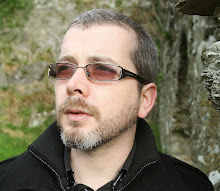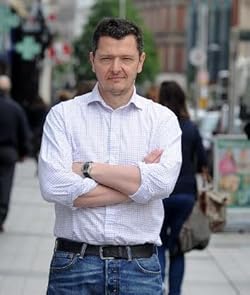
JASON JOHNSON'S novels focus on people facing extreme situations over short periods of time.
His latest is ALOYSIUS TEMPO (2015), the tale of an unkempt, maverick assassin recruited by the Irish government. It's published by Liberties Press, Dublin.
Previous works:
WOUNDLICKER (2005) - a serial killer's confession - set in Northern Ireland.
ALINA (2006) - the hunt for a vanished sex worker - set in Romania.
SINKER (2014) - where drinking alcohol is a professional sport - set in Majorca. (SINKER extract available for free in 'HERE'S THE STORY' - Download from this page)
The Irish Independent describes blackly comic SINKER as "a lean, nasty, tripped-out shocker... a cracking book, a jolt to the senses like a line of flaming shots."
ALINA, says US author and critic Frank Sennett, "delivers a climax as harrowing as one might hope to find in contemporary crime fiction."
And WOUNDLICKER is "dark and gritty", says The Sunday Times.
Jason's from Enniskillen and lives in Belfast.
Gerard: I've only just finished Aloysius Tempo and I feel like there's a hell of a lot of potential for further adventures featuring this protagonist. Maybe because he seems better built to handle his self-destructive nature than your previous characters. Any chance of a sequel?
Jason: I think so. I’m hoping to write another one next year. Ideally I will write four or five adventures for Aloysius.
In each he will lose a body part or two and become a few percentage points more insane and haunted. Basically, he’s spiraling downwards, deconstructing himself. Chapter by chapter he’ll grow weaker yet more dangerous and end up being ground into the dust. This book, I hope, has teed that up.
Next year I plan to write the second installment, to send him to join ISIS on effectively a suicide mission for Ireland just on the cusp of the state’s centenary.
As a character he is going to move further beyond living and operating within established moral frameworks, so Syria seems like a good place for him to be next time around.
Gerard: Nationalism was very much a theme in the first book. Looks like that'll be the case for the future instalments too. Is this your way of wrestling with your own national identity?
Jason: You know, it probably is. My roots are Irish, English, Scottish, Maori, Protestant, Catholic and atheist. Anyone who wants to insult me has a lot of material to work with. A few of my characters have been mongrels in the Northern Ireland sense of the word, so you’re probably right.
The thing I wanted to touch on in the novel was patriotism, which is at the heart of a lot of our gut reactions here. Patriotism can be intoxicating, joyful, positive, negative, childish and laughable all at the same time, and it’s always around.
Aloysius grew up hating Irish society – the Troubles, the church, the ethos – so he’s a bit stuck when he gets asked if he will kill for his country, yet he can’t help seeing some nobility in it.
The book explains how he isn’t sure who his father was, that Aloysius was born to a woman who had been with both a ruthless member of the IRA and a ruthless UDR soldier.
That lack of clarity, lack of category in Irish terms, interests me. It suggests betrayal may mean something different to him than it does to the rest of us. It hopefully creates unexpected friction or unexpected ease in some of his decisions.
Aloysius’ journey basically involves him falling in love with the modern, smart, reinvigorated Ireland to which he is being introduced, but he may stop in with a mistress along the way.
Gerard: So you yourself are hard to classify. What about your writing? To me, Aloysius Tempo is a terrific black-comedic thriller. Your previous novels (Woundlicker, Alina and Sinker), while all quite different animals, contain crime elements of varying degrees, though they might not be found in the crime fiction section at a local bookshop. Do you consider your work literary fiction, crime fiction, comedy or some sort of mongrel?
Jason: Some sort of mongrel. It's about trying to cram relatively big ideas into the heads of people who don't always want them.
I always find I’m trying to write the thoughts of characters who realise they are discovering truths.
For some reason they first seem to end up finding some purity outside of themselves – great works of art, people of beauty, people who possess or who have achieved great things – and I bounce them off that. That helps give them something to compare themselves too, and generally helps them realise how far they have to go in their journey. If there’s literary lingering in my novels, that’s the only sort of thing the characters linger on.
That sounds so wanky that it may, in some small way, suggest the hue of literary fiction. But that would be unfair to the majority of the text which is, more or less, the written equivalent of dropping characters down lift shafts and seeing what happens.
There is always crime, which may suggest some hybrid of crime fiction, but I do think if I called myself a crime writer then crime writers would whisper that I didn’t really understand the genre. The same goes if I called myself a writer of literary fiction.
What I know for sure is I’m never going to write a great novel in the grand sense of the word, but hopefully I am going to entertain.
The stories are usually a bit dark, with a bit of a laugh, with some dirt and violence and hopefully a few off-road plot points. I try to be brave when I write and usually urge myself forward when I hear the voice of the self-censor in my head. I deal with the resulting shame and cringing after the book is published.
All I really want is for my books to shove people a wee bit.
Gerard: Through your four novels you've created a fascinating universe. Do you think Aloysius could ever run into Woundlicker's Fletcher Fee on a future adventure, or do you see your other titles as quite separate?
Jason: Only a writer who knows the craic could ask that question. You too, Gerard, must have entertained the idea of having characters from different novels impact on each other. (Yup! gb)
It’s fun to think about it, to see if you can come up with a plot to reanimate and connect unconnected characters you’ve enjoyed writing before.
But it would be too indulgent at the seriously low level I’m on as a writer. It would likely bypass just about anybody who read it and probably fall flat.
Characters are created at specific times with a specific job to do, so I don’t think it’s a road I’d go down. I’ve plenty of other scumbags and fools I want to write about without bringing any back.
Gerard: Any plans for a reprint of Woundlicker and Alina? Loved those books and I think more people should have the opportunity to read them.
Jason: That’s very kind of you, and no. I think they’re effectively goners, arriving just before the e-book thing did. Neither sold very many so making an argument for reissue would probably fall at the first hurdle.
Anyway, that was then and this is now.
Woundlicker was very local and set during the horrible birthing pains of the peace process. It’s far out of sync with today.
I did once look into the idea of Woundlicker as a one-man stage show, with a real Mercedes Benz on the stage (it’s set in a Merc), but no theatre people were interested.
And when I think back to Alina I think only of it being some kind of half-arsed, mis-developed statement about the cruelty of pleasure when rich meets poor or some such bollocks, so I hope it’s unavailable forever.
It’s all about looking ahead.
Jason Johnson is published by Liberties Press, a house that had the good sense to sign a band of particularly talented Northern Irish writers that includes Tara West, Jan Carson, Kelly Creighton, Bethany Dawson, Moyra Donaldson and Jason himself. Keep 'er lit, lads!
You can follow Jason on Twitter, and if you're lucky, he might even be your friend on Facebook.