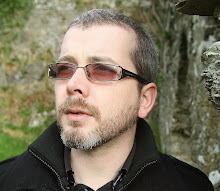
John Connolly was born in Dublin in 1968. He is no longer a ‘wunderkind’, if he ever really was, which saddens him greatly.
Q1. What are you writing at the minute?
I’m working on the latest draft of THE LOVERS, which is the next Charlie Parker novel. It’s been a frustrating business because I managed to delete a large section of the book earlier in the year, which set me back somewhat as well as taking a little of the wind out of my sails. It’s always difficult to judge a book at this stage. Actually, I find it hard to judge most of my own work at any stage, but I like the fact that it’s different from the previous book, which was very straightforward and action-oriented. It strikes me sometimes that each book I write is a reaction to the one that preceded it.
Meanwhile, I’m wondering what to do next. I have about four ideas that I’d like to pursue, two of which would not be series novels, and one of which isn’t crime at all. It's always a little worrying, that moment. I live in fear of choosing a bad idea, then finding halfway that I've written myself into a dead end. But perhaps there are no bad ideas, just the bad execution of them.
Q2. Can you give us an idea of John Connolly’s typical up-to-the-armpits-in-ideas-and-time writing day?
If I did, I’d be lying. I never seem to have quite as much time as I would like, and I’m never sure of the quality of my ideas until I start turning them into books. I’m usually at my desk by nine or nine-thirty, and then I work until lunchtime. I take a break to go to the gym, or just to read in a coffee shop somewhere, and then I’ll do a little more in the evenings, depending upon where in a book I am. At the moment, as I’m rewriting, I tend to stick to working on one chapter each day, as I find I skim over stuff otherwise. So, for now, I work on THE LOVERS in the morning and, at the moment, I’m reading the paperback proofs for THE REAPERS in the afternoon and evening. That’s tedious work, but necessary. Little mistakes are made when the book is typeset anew, and it’s a final chance to correct any repetitions of words or small errors that might have made their way into the hardback. I’m always amazed when writers tell me that they don’t bother with reading the page proofs, either hardback or paperback. It seems like the dumbest thing in the world to imagine that mistakes might not have crept through.Q3. What do you do when you’re not writing?
I’m very dull. I read, I go to the gym, I watch TV, and I go to the movies. Then again, a lot of my year, when I’m not writing, is taken up with promotion, so when I’m home I tend to enjoy doing very mundane, but enjoyable, things. There’s a lot to be said for taking pleasure in simple pursuits.
Q4. Any advice for a greenhorn trying to break into the crime fiction scene?
I’ve never been one for giving advice, really. Each writer, whether published or hoping to publish, tends to be sui generis, and I’m distrustful of people who believe that other writers hold some kind of magic formula for success. I was in a taxi from Dublin Airport once, and made the mistake of telling the taxi driver what I did for a living. He told me that he was writing a book too, but was having trouble with some of the words.
“Where do you get all those words you use?” he asked me.
Um, er, well, when I’m stuck I use a dictionary.
I got a sneer from the driver’s seat. “Ah, a dictionary,” he said, in the tone of one who has just been told that the guy next to him had cheated on his exam.
In the absence of being able to assist people by selling them words on the black market, the only things I would say are that it’s necessary to persevere, as most writers suffer a lot of rejection before they’re published. Write what you’d want to read yourself, not what others are writing or what you think is popular at the moment. By the time you write it and submit it and, if you’re lucky, it’s published, that particular bandwagon will be long gone. Write a little every day, rather than imagining that you’re going to get half a book done over a weekend. And then rewrite. Then rewrite some more.
Q5. Which crime writers have impressed you this year?
Oh hell. Um, I haven’t read as much crimewriting as I used to over the past few years. I think I began to feel that a lot of it was repetitious, and I realised that there were all these other writers out there, both fiction and non-fiction writers, who were doing really interesting things. I liked Michael Chabon’s The Yiddish Policemen’s Union, even if Chabon is too clever by half, and knows it. Then again, I’ve recently discovered Don Winslow, and I think he’s wonderful: The Winter of Frankie Machine, The Power of The Dog… His new book, The Dawn Patrol, is also superb. I never thought I’d say that about a book that featured surfers.
Daniel Silva is also another new discovery for me. Those Gabriel Allon books are real pageturners, although I’ve yet to encounter a nice Arab in them, which makes me a bit suspicious. I’ve always been a sucker for espionage novels. I got to give Robert Littell a jacket quote a year or two ago, which I was actually honoured to do. He’s the American le Carré, I think, and I hauled THE COMPANY around in hardback a few years ago and didn’t begrudge him even the slightest twinge that it caused my back.
Q6. What are you reading right now?
A book called Hellraisers, which is a fairly lighthearted look at the careers of Oliver Reed, Richard Harris, Richard Burton, and Peter O’Toole. The writing is a bit horrible, though, all faux-laddishness. I occasionally feel like I’ve accidentally picked up a copy of Nuts magazine. After that, I have some manuscripts and ARCs to read, for some of which I’ve been asked to give jacket quotes. There’s only so much of that you can do each year though. Apart from gaining a reputation as a quote whore, it becomes a bit like homework, and there are a lot of books for which I’ve paid my own money that I’d kind of like to read as well.
Q7. Plans for the future?
Uh, not dying. That apart, I’m anxious to write the non-crime novel (well, it has a little bit of crime in it, but it’s historical and will be a bit of a departure), but there will be a lot of research involved so there may be a more mainstream book after THE LOVERS before that one comes along.
Q8. With regards to your writing career to date, would you do anything differently?
I don’t think so. I haven’t ended up in a bad position, all things considered. Mind you, I remain the only author to have been rejected by the Richard & Judy Book Club on the grounds of bestiality. Apparently, they didn’t like it when Little Red Riding Hood went off with the wolf in THE BOOK OF LOST THINGS. For a while, I used to wake up in the morning, then clutch my head and scream at the thought of what the selection might have done for that book, which I love dearly but didn’t have much luck at the time it was published. After a while, though, I started to wonder if I was the only person who didn’t think that the tale of Little Red Riding Hood was just about wolves dressed up as grannies. So, in retrospect, I wouldn’t even change that detail.
Q9. Anything you want to say that I haven’t asked you about?
You haven’t asked me if I’m well. I’ll start to think that you don’t care . . .
Thank you, John Connolly!

 list of the top fifty paperbacks as judged by a triumvirate of Times-type folk. Only two of the fifty actually feature on my bookshelf, though. Bateman’s Mystery Man and The Reapers by John Connolly. I wonder if I should construct my own top fifty... Mightn’t be worth the effort. I mean, it’s not like I’m in a position to offer a cash prize to the top three or anything. Still, might mean more to the average CSNI reader, legion that you are.
 list of the top fifty paperbacks as judged by a triumvirate of Times-type folk. Only two of the fifty actually feature on my bookshelf, though. Bateman’s Mystery Man and The Reapers by John Connolly. I wonder if I should construct my own top fifty... Mightn’t be worth the effort. I mean, it’s not like I’m in a position to offer a cash prize to the top three or anything. Still, might mean more to the average CSNI reader, legion that you are.