Showing posts with label Hard Case Crime Week. Show all posts

Monday, 24 November 2008

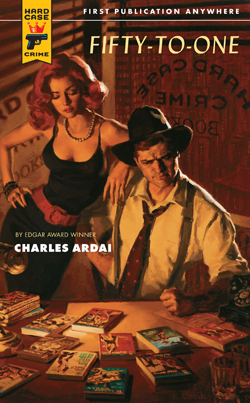
A Wee Review - Fifty-to-One, by Charles Ardai


The concept of this book is an interesting one. Charles Ardai (along with Max Phillips) founded Hard Case Crime just about five years ago with the intention to bring the world “...the best in hardboiled crime fiction, ranging from lost noir masterpieces to new novels by today’s most powerful writers, featuring stunning original cover art in the grand pulp style.” A commendable mission statement, wouldn’t you say? Or is it a company objective? I can’t remember.

Anyway, back to the book’s concept. Fifty-to-One is the fiftieth pulp-style paperback to be released under the HCC label, and to mark the achievement, Ardai challenged himself to write an old fashioned crime caper with a chapter named after each of the books in the series. In the order they were released! What a cool idea. But what kind of a man puts himself through something like that?

A talented one, it would seem.

The more cynical among us might point out that Ardai is in a pretty nice position as editor of HCC, and to release a novel through your own publishing imprint isn’t as big an achievement as it would be to sell it somewhere else. Well, I’m not that cynical. Not anymore. Because in reading Fifty-to-One I’ve gained at least a little insight into what Ardai must have put himself through to make it fly. I mean, some of those chapter titles are just out there, yet they all snap into place to form a great tale.

Set in the 1950s the story is told, for the most part, through Tricia Heverstadt, a wet-behind-the-ears country girl from South Dakota. She arrives in New York City at the start of the book and in the first chapter, titled Grifter’s Game, she learns what kind of place the Big Apple is. Penniless and homeless in a city she doesn’t know, and there’s so much more bad luck to come. There are less than a handful of POV switches, including a chapter from a fictional not-so-true crime novel (published by a shady house with a name you might recognise), but Ardai has a nice method of passing the baton from one character to another that keeps it all tidy.

Ardai spins us a fun, comedic yarn featuring smokin’-hot dames, Keystone-type cops, ‘Shut Uppa You Face’ Italian mobsters, crooked bookies, blackmailers, unlicensed boxers, smut-peddling publishers and crime fiction writers. And that’s only the half of it. The writing is straight-forward, the dialogue snappy, and the excitement, twists and action scenes are ever-present. Characters by the name of Spillane, Block and Westlake show up too! It’s a book about bad luck and moxie in the face of adversity. The only thing that disappointed me was the underuse of the word ‘moxie’ but I’ve made up for that now.

The plot is of the variety employed by Declan Burke in his crime caper, The Big O. Fun-filled and coincidence-ridden with some dark undercurrents driving the characters’ motivations. It’s a lovely combination and I’m impressed. But then, you’d expect quality from a writer whose past work has earned him a Shamus Award. Yup, that’s right, folks, a little bit of amateur detection turns up the fact that Charles Ardai’s pseudonym is Richard Aleas (Dick Alias?), and his novel Songs of Innocence won best PI paperback in 2008.

Fifty-to-One is a wisecracking novel from a wizened and highly-respected era. Thanks be to Hard Case Crime for bringing back this kind of book. I want more. Luckily, I’ve a copy of The Max by Ken Bruen and Jason Starr at hand. And I wouldn’t mind a few more titles from the range for Christmas. Just putting it out there guys. Still plenty of shopping days left...

Sunday, 23 November 2008

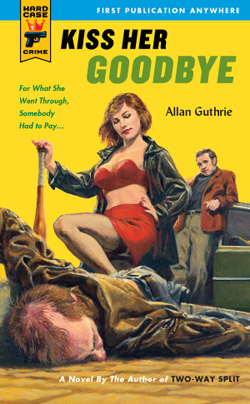
A Mini Interview - Allan Guthrie


ALLAN GUTHRIE (Kiss Her Goodbye)
Allan Guthrie’s first novel, Two-Way Split, was shortlisted for the CWA Debut Dagger Award and his short stories have appeared in a variety of magazines and anthologies. He is also the creator of the Noir Originals Web site and commissioning editor for both Point Blank Press and the Pulp Originals line of e-books. Guthrie lives in Edinburgh, Scotland, on whose mean streets his books are set

Q1. Hard Case Crime seems to have become almost a sub-genre over the last five years. To be involved in it must feel like you’ve become part of an exclusive club. What have been some of the highlights of this membership?

Any club that lets me in can't be that exclusive! But, yeah, when I signed my contract with Hard Case I was unpublished. For a new writer trying to kickstart a career, Hard Case was a godsend. Charles Ardai had a very clear vision of what he wanted to do, and the passion and expertise to make it happen. So although I was signed up very early on, I knew I was in safe hands. Highlights for me have to include being edited by Charles, who is one of the most insightful editors in the business, and the Edgar nomination that ensued. The latter would never have happened without the former.

Q2. It’s all about hardboiled, noir and pulp fiction at Hard Case Crime. The golden age of paperback novels in revival. What do you think the future holds for this type of book?

When I first started writing in 2001, noir was a dirty word. The market's a lot more inclusive now, and noir has become much sexier (that's a technical term used in marketing, btw). Hardboiled/noir/pulp is still a niche market, but it's a lively one and if it continues to attract good writers, it'll be around for a while yet.

Q3. One of the most striking things about the Hard Case novels is the beautiful cover artwork. How did you feel when you first saw the cover for your book? How did it compare to the conception of the characters you had in mind when you were writing your book?

I'd have to add seeing the cover for the first time as one of the highlights of my HCC 'membership'. Charles asked if I had any ideas for the cover, so I mentioned a particular scene that contained some interesting dynamics. And a few weeks later, he sent a mock-up of exactly that scene. When I first saw it, I couldn't believe how breathtakingly brilliant it was. The artist, Chuck Pyle, did a helluva job. The characters bear absolutely no resemblance to the ones I had in mind when I was writing the book, but that's not a bad thing.

Q4. What are some crime novels or authors, either within or outside Hard Case, that have impressed you this year?

I'll restrict myself to Hard Case-type noirs or we'll very likely be here till Hard Case's 100th anniversary. Bent cops have made quite an impact this year. Dave Zeltserman's SMALL CRIMES is his best novel to date, with the promise of even better to come next year with PARIAH. Another bent-cop noir is Anthony Neil Smith's YELLOW MEDICINE, with a sequel due out next year called HOGDOGGIN', which blew me away when I read it in manuscript. Tom Piccirilli's become one of my favourite writers over the last couple of years and THE COLD SPOT is a terrific noir about a getaway driver (check out last year's THE FEVER KILL too -- a modern Gold Medal if ever I read one). Debut Canadian author Mike Knowles wrote a hardboiled gangster novel called DARWIN'S NIGHTMARE that reminded me an awful lot of Paul Cain's THE FAST ONE (Knowles's book is intelligible, though!). Christa Faust's MONEY SHOT is a superb unsentimental hardboiled revenge story. SEVERANCE PACKAGE is another classic from Duane Swierczynski. Here in Scotland, Ray Banks continued to show why he's one of the best crime writers in the country with NO MORE HEROES, Edinburgh got a new voice in Tony Black's Gus Drury, who debuted in PAYING FOR IT, and Dundee finally got on the crime fiction map with Russel D McLean's dark and lean PI debut, THE GOOD SON.

Thank you, Allan Guthrie!

Saturday, 22 November 2008

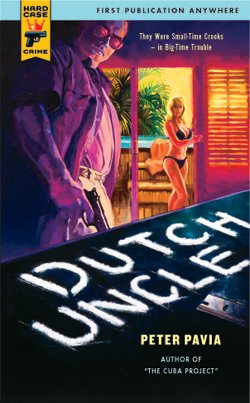
A Mini Interview - Peter Pavia


PETER PAVIA (Dutch Uncle)
Peter Pavia is a writer whose work has appeared in many publications, including GQ, The New York Sun, The New York Post and The New York Times, among others. In addition to Dutch Uncle, he is the author of The Cuba Project—Deception, Dirty Doings, and Double Dealing in Post-Castro Miami and co-author, with Legs McNeil and Jennifer Osborne, of The Other Hollywood: An Oral History of the Adult Film Industry. He has been a faculty member of The New School’s Writing Program since 2001. A Rochester, New York native, Mr. Pavia moved to Manhattan in 1984, where he currently resides with his wife and daughter.

Q1. Hard Case Crime seems to have become almost a sub-genre over the last five years. To be involved in it must feel like you've become part of an exclusive club. What have been some of the highlights of this membership?

I came to Hard Case Crime and to the series’ award-winning writer, editor, and publisher Charles Ardai through an overlapping series of events that were spearheaded by an old school publishing exec by the name of Larry Hughes. (Hughes's quote adorns the back cover of Dutch Uncle). From my very first conversation with Charles, I was convinced that he was totally with the novel in the way it was written, recognized its strengths and its shortcomings, its references and influences. I thought, finally, a kindred spirit. Everybody loved Dutch in manuscript, but nobody knew how to sell it. Charles had a strategy. His enthusiasm and know-how were extremely encouraging. He gave me a break when I needed one, and gave me the guts to write another day. I'm not a numerologist, but Dutch squeaked under the wire as the 12th Hard Case Crime novel on the original list of 12, the number of fullness, of completion. The publication of Dutch Uncle convinced me to stop attributing everything to coincidence and further persuaded me that there is some positive force in the universe. How's that for a highlight?

Q2. It's all about hardboiled, noir and pulp fiction at Hard Case Crime. The golden age of paperback novels in revival. What do you think the future holds for this type of book?

The whole idea of pulp bugs me. Tabloid newspapers are pulpy, formulaic westerns are pulpy. Chop-socky movies are pulpy. This doesn't mean that I don't love those things, but in terms of what I like to think of as crime fiction, 'pulp' suggests badly written books cranked out at a couple of pennies a word, and a complete manuscript that's dashed off in about a month. I'm not going to name names here, past or present, and this stuff has its place, but it is in the main, unreadable crap that isn't worth anybody's time.

Hardboiled is a style more or less invented by Dashiell Hammett and yes, Ernest Hemingway (and James M. Cain), in the 1920s. Go back and look at the stylistic similarities between say, The Maltese Falcon and The Sun Also Rises. These writers were craftsmen who created real literature; Hemingway won a Nobel Prize for Christ's sake. I could make the argument that Fitzgerald's The Great Gatsby is a crime novel, and some grad student probably should probably take up that mantle. (Are you listening, MFA candidates? I just gave you a thesis.) I think the future holds a healthy respect for the genre, but in the form of well-wrought books that strive to expand noir's (if you will) somewhat narrow parameters. This is precisely what I've set out to accomplish with my current novel, This Fallen Kingdom, and I'll be very curious to see what Hard Case fans make of it.

Q3. One of the most striking things about the Hard Case novels is the beautiful cover artwork. How did you feel when you first saw the cover for your book? How did it compare to the conception of the characters you had in mind when you were writing your book?

Hey, man. Close enough for rock n' roll. This guy Farrell is an artist, and what he sees in his mind is different than what I see in mine, or what you might see in yours. How did I feel? I was so gratified I almost cried. Maybe I did cry. "Awfully easy to be hard-boiled about everything during the day," Hemingway said, "But at night it is another thing."

Q4. What are some crime novels or authors, either within or outside Hard Case, that have impressed you this year?

Dirty little secret time: I don't read much crime fiction. I spend a great deal of time writing, and I tend to read non-fiction that's going to inform my own work. Having bloviated thusly, I'm a huge admirer of George V. Higgins, especially The Friends of Eddie Coyle. I think James Ellroy is wildly entertaining. As for my Hard Case Crimeys, Pete Hamill was my hero when I was a kid, and that's not an exaggeration. He was the guy I wanted to be when I was 14. I'm dying to read Charles Ardai's Fifty to One, and I'm curious about E. Howard Hunt's House Dick. I was fortunate enough to become friendly with Hunt near the end of his days, and the guy was simply larger than life, even in his 80s. There was almost nothing he hadn't done, and he had participated in so much dark history, including falling on his sword for the Nixon gang after the Watergate mess. Howard Hunt was a great American.

Thank you, Peter Pavia!

Friday, 21 November 2008

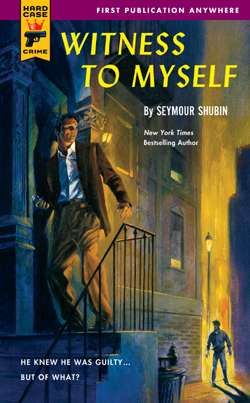
A Mini Interview - Seymour Shubin


SEYMOUR SHUBIN (Witness To Myself)
In 1953, Seymour Shubin published his first novel, Anyone’s My Name. It quickly became a New York Times bestseller and went on to be recognized as a classic of the field, published in numerous international editions and taught in college courses on both literature and criminology. Subsequently, Shubin wrote more than a dozen other novels, including one, The Captain, that was a finalist for the Edgar Allan Poe Award and selected for the mystery reference work 100 Great Detectives.

Q1. Hard Case Crime seems to have become almost a sub-genre over the last five years. To be involved in it must feel like you’ve become part of an exclusive club. What have been some of the highlights of this membership?

The first highlight that comes to mind is my experience with Charles. His editing was always right on target. He was quick to reply to whatever questions or comments I had. I was delighted too by the general reaction to the novel. I had wondered whether my story of a man who was tortured by the memory of a murder he'd committed when he was a teenager, whether that fit under the umbrella of noir. The reactions my book got--some the highest praise any writer could hope for--quickly put that concern to rest. Noir is not a stereotype of hardboiled characters, shootings, and so on. Among so many other things, it can include the horrors that the mind under stress can inflict.

Q2. It’s all about hardboiled, noir and pulp fiction at Hard Case Crime. The golden age of paperback novels in revival. What do you think the future holds for this type of book?

I think the future of the noir novel, in all its forms, is strong and bright. For one thing, to put it simply, these novels offer sheer entertainment. For another, and far more complex, they enable the reader to enter a world of emotions and action that he/she shares with the writer in a you-are-there way.

Q3. One of the most striking things about the Hard Case novels is the beautiful cover artwork. How did you feel when you first saw the covers for your books? How did they compare to the conceptions of the characters you had in mind when you were writing your books?

I was delighted with the cover. Although it did not specifically portray a particular scene in the book, it conveyed far more--the essence of the novel itself: entrapment and pursuit. I wish I owned it.

Q4. What are some crime novels or authors, either within or outside Hard Case, that have impressed you this year?

I'm afraid I've been so busy writing my own new novel, and haven't wanted to be influenced, that I haven't read any crime novels this year.

Thank you, Seymour Shubin!

Thursday, 20 November 2008

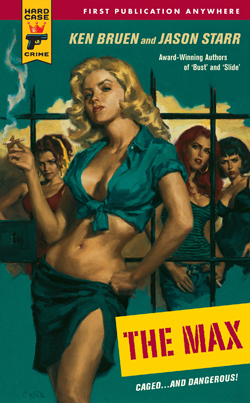
A Mini Interview - Ken Bruen


KEN BRUEN (Bust, Slide, The Max)
The Galway, Ireland-born author of more than a dozen extremely dark crime novels, Ken Bruen was nominated for nearly every major award in the mystery field (and won the Shamus Award) for his book The Guards, the first in his series about Jack Taylor and his first book to be published in the United States. In addition to his work as a novelist, Bruen has a Ph.D. in metaphysics and spent 25 years as a teacher in Africa, Japan, Southeast Asia, and South America.

Q1. Hard Case Crime seems to have become almost a sub-genre over the last five years. To be involved in it must feel like you’ve become part of an exclusive club. What have been some of the highlights of this membership?

To really be part of the most innovative, exciting publishing event of the past 50 years, the covers, who wouldn't kill to see their name on one of those stunning collectors items and to work with Charles, not only fun but a great challenge.

Q2. It’s all about hardboiled, noir and pulp fiction at Hard Case Crime. The golden age of paperback novels in revival. What do you think the future holds for this type of book?

I think it will make the fat cats sit up and clean up their snotty act, to see that a real committed publisher, who obviosuly cares deeply about the readers is going to make them get off their ivory towers.

Q3. One of the most striking things about the Hard Case novels is the beautiful cover artwork. How did you feel when you first saw the covers for your books? How did the art compare to the conception of the characters you had in mind when you were writing the books?

I went...Holy Fook...still do, and the third cover is the most stunning of all.

Q4. What are some crime novels or authors, either within or outside Hard Case, that have impressed you this year?

Richard Aleas, and here's rooting for that Shamus award; Brian McGilloway, he knocks me out; Tony Black, Megan Abbot, Adrian McKinty, the guy is a friggin genius; Christa Faust; Jason Starr, with his new standalone due soon.

Thank you, Ken Bruen!

Wednesday, 19 November 2008

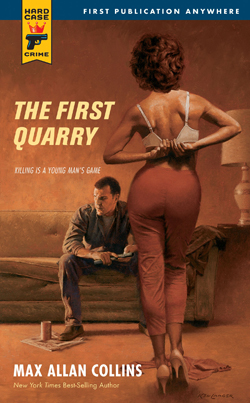
A Mini Interview - Max Allan Collins


MAX ALLAN COLLINS (Two For the Money, The Last Quarry, Deadly Beloved, The First Quarry)
Author of Road to Perdition, the acclaimed graphic novel that inspired the movie starring Paul Newman and Tom Hanks, and of the multiple-award-winning Nathan Heller series of historical hardboiled mysteries, Max Allan Collins is one of most prolific and popular authors working in the hardboiled field today. He is also a filmmaker whose work includes "Shades of Noir," "Real Time," and the documentary "Mike Hammer’s Mickey Spillane."

Q1. Hard Case Crime seems to have become almost a sub-genre over the last five years. To be involved in it must feel like you’ve become part of an exclusive club. What have been some of the highlights of this membership?

I knew from the start that I wanted to be part of Hard Case Crime -- it reflected exactly the kind of book I grew up on, the quarter/35-cent reprints of Spillane, Hammett, Chandler, James M. Cain, and the Gold Medal and Dell originals, Jim Thompson, Richard S. Prather, John D. MacDonald. Those books, with their vivid sexy covers, connected with me as a teenager, and led me to where I am, for good or ill.

Frankly, some people advised against getting involved, at least doing originals, because I can get better money elsewhere. But Hard Case has given me the opportunity to write whatever I choose, essentially -- getting to re-visit my Quarry character, for example, or do a Ms. Tree prose novel. The bonus has been that these books of mine have connected with both readers and reviewers, and have attracted attention to my work in general. THE LAST QUARRY is now a film called THE LAST LULLABY, from a script co-written by me.

Q2. It’s all about hardboiled, noir and pulp fiction at Hard Case Crime. The golden age of paperback novels in revival. What do you think the future holds for this type of book?

There will always be a place for the noir novel -- the crime novels that have heists at their center, or murderous love triangles, or private eye novels with vengeance and/or femme fatales as their engines. They may change physically -- although I think the retro look, recalling not just old paperback covers but movie posters and the films themselves will have enduring appeal. Beautiful women and masculine guys in provocative situations, both in the stories and on the covers, have a lasting drawing power.

Q3. One of the most striking things about the Hard Case novels is the beautiful cover artwork. How did you feel when you first saw the covers for your books? How did they compare to the conceptions of the characters you had in mind when you were writing your books?

I was disappointed in TWO FOR THE MONEY, because I'd been keen to have a really strong, old-fashioned paperbacky cover and I got a fairly stilted design with a guy as my Nolan character (who was overtly described as Lee Van Cleef) looking like Nick Nolte. And I only did my first original because I dared Charles Ardai to get me Bob McGinnis. I said, "Get me a McGinnis cover, and I'll do a new Quarry novel." By God, he came through. The subsequent covers have been fabulous, including the Ms. Tree cover by her co-creator, my longtime collaborator Terry Beatty.

But striking covers aren't enough. Hard Case would be gone by now if the books themselves hadn't been worthwhile.

Q4. What are some crime novels or authors, either within or outside Hard Case, that have impressed you this year?

I read very little fiction. I am almost always researching for the historical crime novels I'm doing or hoping to do. And when I do read crime fiction, I often pick out a series and read straight through. I did that with Perry Mason, Poirot and Nero Wolfe, and not long ago did the same with the Inspector Morse novels, having loved the TV series.

The mystery stuff I've loved in recent years has been TV series, mostly British -- LIFE ON MARS and its sequel ASHES TO ASHES, FOYLE'S WAR, the MORSE spin-off LEWIS, SPOOKS (M1-5), HUSTLE and one American show, VERONICA MARS, which is one of the great PI series.

Thank you, Max Allan Collins!