Sunday, 29 June 2014

Flash Fiction from Dana King


LILY IN BLUE


Eldrick’s had a nice crowd for Tuesday night. About half full of the usual clientele, people with more money than was good for them, looking for peers to indulge what would be called perversion if practiced by a lower socioeconomic caste.
The sound system calibrated so you could hear everything your target said and still be able to plead ignorance if necessary. She came in halfway through The Eurhythmics’ “Sweet Dreams.” A redhead now, wearing an electric blue sheath. I almost didn’t recognize her, just the sensation of seeing a person who reminded me of someone else until I glimpsed her aquamarine eyes. No one who saw those eyes ever forgot them.
She sat at a table big enough for two drinks and a small bowl of nuts, had Eldrick’s been that kind of place. I waited until her drink arrived and sat down without being invited.
“Hello, Lily.”
She looked at me without recognition for a couple of beats, then blushed to the roots of what used to be blond hair. “Nick Forte? Oh my God! What are you doing here?”
“Working,” I said. “I hope you aren’t.”
Her eyes flickered to the table, then back. “I don’t do that anymore. Not since…my mother…you know.”
“I’m glad. Really. Look, I won’t stay. Don’t want to limit your availability. I’m sorry. That didn’t come out right. You know what I mean. Like I said, I’m working. A cheating husband job. Lots of pre-nup money at stake. It really is good to see you. You look great.”
“Can you stay a minute?” It popped out like she’d been holding it back.
“Sure, if you want. I can watch for this guy just as well from here. I’ll get my drink.”
“I’m in trouble.”
I left the drink. I didn’t owe Lily O’Donoghue a thing; I’d always owe her mother. “What kind of trouble?”
“That money you gave me—”
“Your mother gave you. I just delivered it.”
“Okay, my mother gave me. I didn’t waste it. I got a Masters at DePaul and used the rest to buy into a psychology practice. We’re doing very well.”
“I knew you would.”
She went on like I hadn’t spoken. “Someone recognized me. From before. Said he’d ruin me if I didn’t pay him.”
“Does that kind of leverage work on a shrink?”
“Not usually. A lot of psychologists have pasts they’d rather not talk about. It’s why we get into the field. The videos he has are the kinds of things you can’t live down. I’d have to leave the practice, leave Chicago. I worked hard for this, Nick. I don’t want to give it up. But I know it won’t stop with just once. He’ll be back for more and more and more. The money I have is tied up in the practice. He can ruin me.”
“What was the plan before I showed up?”
She blushed. “Work out a deal for less money…”
I raised a hand. “I’ll do what I can. Point him out to me when he comes. Give him what you have, tell him you need more time, and make sure he leaves without you. Wait ten minutes, then go straight home. Now act like you’re shooting me down, in case he’s watching.”
He must have been, moved in before my seat had a chance to cool. Almost handsome, early forties, in good shape, nice suit. They talked for five minutes. She laid an envelope on the table. He opened it and counted the money—amateur, counting it in public—then took her wrist in his hand so I knew it had to hurt even though I couldn’t hear. I stayed put. He wouldn’t do anything dangerous in public, and she’d only scare so much, knowing I was around.
He stood and I left before he had a chance to notice me, waited outside by the valet station. He led me to an unlighted house in Elmhurst, pulled into an attached garage while I killed the headlights and drifted to a stop in front. A light came on inside. I took what I needed from my car and rang the bell.
He answered the door with a look between confused and irritated. I opened the switchblade from my car’s console and sliced his tie off right below the knot. His mouth fell open and I stuffed the tie in it.
“I want the money you picked up in Eldrick’s and all the videos.”
He made a sound. Could have been, “What videos?” Hard to tell with the tie in his mouth.
I stuck a leg behind his knee and took him down hard. Pried his jaws apart and started feeding the tie down his throat. “I want everything,” I said. “Slap the floor when you’re ready. Don’t wait too long. You pass out and I’ll leave you for the coroner.” He gave the sign before I could start again.
I pulled out the tie. “The money first.”
“On the island. In the kitchen.” I nodded that way and he led me to it.
“Now the movies,” I said.
We went into a den near the front door. He handed me a jewel box with a disc in it. “That’s the only copy.”
I nodded toward his computer. “There’s a file in there, though. Isn’t there?” He didn’t say, but he might as well have.
Neither of us spoke while the laptop booted. When it finished he moved for the chair.
“I got it,” I said. Brought up a command prompt, typed “format c:” and hit Enter.
“Jesus Christ, that’s my business computer. You’ll ruin me. Who are you?”
“I’m the guy who’s coming back here if she ever even sees you crossing the street again. We good on that?”
I mailed the money to Lily. Broke the disc before curiosity got the better of me.


Enjoy it? Check out Dana's novels, then!


Thursday, 26 June 2014

Soldier, Soldier - A Dana King Guest Post


Detective Nick Forte, the hero of ASmall Sacrifice, has military experience in his background. Not a lot is made of it, but there are elements that help to shape his character between the lines, especially in later books. It stems from my at least partial adherence to the hoary adage, to “write what you know.”

I don’t say much about my time in the United States Army, mainly because I was in a band stationed at Fort McPherson, Georgia. Basically, Atlanta. We performed post ceremonies, did gigs in and around Atlanta, and traveled a few times a year for up to three weeks. Our most hazardous “mission” was to fly in the cargo hold of a C-130 to the Virgin Islands for a Veterans Day concert.

I was a “soldier” in only the broadest definition of the term. Real soldiers have jobs that place them at risk as a matter of course. I did get to spend some time around real soldiers—my drill sergeants were all Vietnam veterans, most of them from the same Air Cavalry outfit depicted in Apocalypse Now, which came out right before I left for basic—and I had the presence of mind to appreciate a chance like this would not pass my way again. I paid attention, asked questions when opportunity presented.

When I first came up with the idea of Nick Forte, I wanted to leverage as much of my experience as I could. We’re both “recovering” musicians with minor military backgrounds. His takeaway from the service—as was mine—is not of the flag-waving, “making the world safe for the American Way of Life ™, American Exceptionalism means we can do what we want” attitude so often portrayed in books, movies, and politics today, but the attitudes of the common soldier. He fights for the men on either side of him, trusting them to fight for him. He keeps his weapon clean and his mind clear under incredible stress, for his mates as much as himself. He may not have a lot of friends, but those he has he trusts with his life, and will exchange his for theirs if called upon. He also will place the task at hand—his mission—above his personal safety. He doesn’t advertise this—beware the man who wears any conviction too much on his sleeve—shows it through his actions. It’s far more deeply embedded in Forte’s psyche than in mine, if only because I routinely place him into at least one life-or-death situation per book.

My small experience with actual boots-in-the-mud soldiers piqued my interest and led me to books and movies that looked at things more from that perspective. Band of Brothers, Generation Kill (both the books and the TV series), Saving Private Ryan, and many non-fiction choices. A downside is, I can’t watch The Longest Day anymore without cringing; soldiers don’t make speeches like that.


The upside is, I hope this has given me an appreciation, if not an understanding, for the mind-set of a combat soldier. (Though I hate the idea of “You have no idea what’s it like unless you’ve done it” in general, I feel safe in saying no one who has not been in combat can truly “understand” what it’s like.) I know it’s helped to make Nick Forte a richer character in my imagination; only readers can decide if I have been able to transfer that to the page.
  

Short additional note from Gerard - A Small Sacrifice and 3 other Dana King books can be nabbed for free for the next few days. Be quick. Get yours now!

Wednesday, 25 June 2014

Hail to the King, Baby

So, it looks as if THE POINT has come to the end of its run as a perma-free book on Kindle. Does that make it semi-perma-free? Who knows?

If you're into answering rhetorical questions, feel free to leave a comment.

Anyway, right now, THE POINT is selling for the princely sum of 29p on Kindle in the UK. In the US it's 49 cents. I know. Them Blasted Heath lads must be having a laugh. Who's going to throw that kind of cash away?

But the good news is (and it's especially good if you only read free books on your Kindle), Dana King's books are now free on Kindle, even the latest, Grind Joint, which I really enjoyed.


"GRIND JOINT by Dana King. The spirit of THE WIRE reincarnated with JUSTIFIED charm. Gangster-rich US crime fiction at its best." I said that on Twitter, like.

So, you know what to do. Save your 29p and get all those lovely free books. Just promise me one thing. Pass the word on, maybe review one of the books, and add Dana to your 'recommend to friends' list, if you enjoy his work. Okay, so that's three things, but it's hard out there for a pimp. I reckon it's even harder for a writer.

Kay?

Kay.

Tuesday, 17 June 2014

New Novel - Coming Soon*

*Don't ask me how soon, exactly... I'm not sure yet. But check out the cover!

Blurb to follow soon enough. Just know that it's the first of a new series that will be published by Blasted Heath. I'm excited about this project and not at all daunted by all those words that have to be written to back up the claim that Cormac Kelly is my new series character.


Wednesday, 11 June 2014

Conference on the Territorialisation of Crime fiction, Queen’s University, Belfast

International Conference on the Territorialisation of Crime fiction
INTERNATIONAL CRIME FICTION RESEARCH GROUP
Queen’s University, Belfast, 13-14th June 2014


The global and the local in contemporary world crime fiction
Circulation and exchanges

Friday 13th June 2014
9:00-9:30 Old Staff Common Room, Lanyon Building, Welcome address from Professor Margaret Topping, School of Modern Languages, Introduction

9:30-11:00 Maps and Regions in Crime fiction
Eva Erdmann (Munich) “Topographical fiction in relation.
International Crime Scenes in Literature and their cartographic Representation”
Christoph Baumann (University of Erlangen-Nürnberg) “Geographies of crime – Regionalization in German crime series “

11:00-11: 30 COFFEE

11: 30-13:00 The Politics of Place
Benoît Tadié (Rennes University) “All Roads Lead to Hollywood... And the Pause That Refreshes:
Re
-routing and Territorializing Hardboiled/Noir fiction in Los Angeles (1930-1950)”
Andrew Pepper ( QUB) “Sovereign Power in an era of Neoliberalism:
State Coercion and Parapolitics in David Peace and Eoin McNamee
”

13:00-14:00 LUNCH, QFT Foyer, 20 University Square

14:00-15:30 Old Staff Common Room Patrimonialisation and Globalisation of the local
Kerstin Bergmann, (University of Lund) “Europeanization and Regionalism in 21st Century Swedish Crime Fiction?”
Gabrielle Saumon (University of Limoges) “From crime fiction to the making of a touristic place.
Ystad, Stockholm: two investigations
”
15:30-15:45 COFFEE

15:45-17:30 Ireland of Crime
Samantha Weyer-Brown (University Paris 3) “Landscape, territories and 'ghost estates' in Tana French, Broken Harbour”.
Fiona McCann (University Lille 3) “Authority, Permeability and the State of the State in
Eoin McNamee’s
Blue trilogy and The Ultras”
Garrett Carr (QUB) “The Map of Connections, illustrated talk”
19:00 No Alibis Bookstore, Botanic Avenue, Reading and questions with invited authors Eoin McNamee and Brian McGilloway
21:00 CONFERENCE DINNER Mourne Seafood, 34- 36 Bank Street, Belfast, BT1 1HL


Saturday 14th June 2014
9:30-11:15 Seminar Room, 21 University Square From Close Reading to Data Visualisation: varying Focalisation in Approaches to Crime Regionalization
Dominique Jeannerod (QUB) “Northern Scenery and Mise-en scène of the Genre in French Crime Fiction”
Jean-Philippe Gury (Université de Bretagne Occidentale) “Blue Guide of Crime: Welcome to Brittany!”
Natacha Levet (University of Limoges) “Building a database for Mapping Regional Crime Fiction in France”

11:15-11:30 COFFEE

11:30-13:00 Negotiating the American Model domestically and globally
Barbara Pezzotti (Wellington) “Giorgio Scerbanenco's Milan and the Domestication of the American Hard-Boiled Novel”
Andrea Hynynen, (University of Turku) “A Feminism too foreign for France? – necessary change of Territory
in the case of Maud Tabachnik’s Feminist Crime Fiction”

13:00-14:00 LUNCH, QFT Foyer, 20 University Square

14:00-15:45 Seminar Room, 21 University Square Localisation and Globalisation
Kate Quinn (University of Galway) “Beyond Chilenidad.
Transatlantic crossings and local inflection in Chilean Crime Fiction”
David Schmid (University of Bufffalo) “City, State, and Globe in the Crime Novels of Paco Ignacio Taibo II”
David Platten (Leeds) “Crossing Bridges: Crime Stories as International Currency”


Wednesday, 4 June 2014

No Alibis Event - Paul Charles


An Evening With Paul Charles-The Lonesome Heart Is Angry
Friday 6th June at 6:30PM
http://www.noalibis.com/images/Lonesome.jpg

No Alibis Bookstore is pleased to invite you to celebrate the launch of Paul Charles' latest novel, THE LONESOME HEART IS ANGRY, on Friday 6th June at 6:30PM. This is a free event.
What seems like a routine job for the matchmaker, Michael Gilmour, in a 1960s small Northern Irish town becomes something very much more when events take an unexpected turn. The brothers Kane have an idea for their matches that will set tongues wagging, light the fires of jealousy in more than one heart, and open the door to tragedy.
The Lonesome Heart is Angry explores life in a small town and the darker side of the human condition. It doesn't shy away from the gossip, the fear, the violence and desperation that can build up inside people and behind closed doors.
Set in Castlemartin, home of the Playboys who featured in Paul Charles' The Last Dance, The Lonesome Heart is Angry is a gripping novel that will keep you reading until the last page.
Paul Charles is a noted author of crime and music books. He works as a music agent and is based in London. New Island published his previous Castlemartin novel, The Last Dance, in 2012.
Book your spot now by emailing David, or calling the shop on 9031 9607.
NO ALIBIS BOOKSTORE
83 BOTANIC AVE
BELFAST BT7 1JL
NORTHERN IRELAND
02890319601

Tuesday, 27 May 2014

Sunday, 18 May 2014

The Reading I Haven't Written About...


Back in January of this year, I blogged about reading and set my self the task of reading and writing about 100 books this year. I've written about 12 books and we're 5 months into the year. Now, I don't claim to be a genius mathematician (seriously, my brain just doesn't do mental arithmetic any more) but I'm pretty sure that I'm running behind schedule here.

Here's the thing; I've read a bunch of books this year that I haven't gotten around to writing about. Maybe I finished reading a book in bed and woke up the next day with too little time to scribble down some thoughts, put it off for a day or two, then forgot to return to it. Maybe I just had something else I wanted to do right after closing a book, put off writing about it for a day or two and forgot about it... you get the picture already, right?

So, I've read more than 12 books this year. Off the top of my head some of the books I've liked or loved enough to remember without a written record are:

Blue is the Night by Eoin McNamee
Steal Like An Artist by Austin Kleon
The Front Seat Passenger by Pascal Garnier
The Thin Man by Dashiell Hammett
The Hunter by Richard Stark
(I suspect there are a few more books that belong on this list, but they've slipped my mind)

I also reread The Maltese Falcon and a good portion of The Glass Key (both by Hammett) as well as the unfinished first draft of The Thin Man in the Library of America edition of Hammett: Crime Stories and Other Writing. A few short stories here and there (from mammoth collections like Hemingway's First Forty-Nine Stories and the Black Lizard Big Book of Pulps, mostly) and the odd chapter from a bunch of books that I wanted to refresh my memory of.

I'd still be running behind schedule, even if I'd written about the listed books, of course, but I'd be comfortable enough knowing that my summer reading boost would have helped a little. I've delivered this year's PhD work to QUB, and following my differentiation at the end of the month, I get a few months to myself (sort of) to read and write before the new academic year starts. This means I'll be free to read whatever I fancy and I'll probably take a break from the academic texts I've been dipping in and out of (I could list those, but I don't think you'd care).

So, do I write about the listed books in retrospect? I'm not sure I want to. I think I'll have lost some of the enthusiasm that sticks with you for a day or two after reading and that'll come through in my short reviews. Plus, I'm clocking up more titles that should go on the list every week or two. But then, these are all books worth talking about. Also, I've a bunch of fiction writing I want to get done (and reading of the work I've written, as the process goes). Or do I just abandon the whole 100 books thing and simply write what I feel like writing about when I feel like it?

You know what? My son wants me to make his some grub right now. I'll think about this later. If I feel like it.

Currently reading The Friends of Eddie Coyle by George V. Higgins and Plotting and Writing Suspense Fiction by Patricia Highsmith, by the way.

Tuesday, 13 May 2014

Four Writers - On Writing...

There are three writers who have been very kind to me over the last year. Each of them has helped promote my books and have reviewed a number of my titles. Without them, my profile would have been noticeably lower. I really believe that. They’re also pretty good friends with each other, so I always think of them as a collective; and as friends of mine.

Now, the thing is, due to my lifestyle, I can’t read and review every book that I’d like to. I barely get the time to read the books essential to the PhD I’m currently working on. But I had an urge to show these writers how much I appreciate all they’ve done for me. Best I could come up with was this lousy four-way interview. But here, I think it turned out all right. So, without further ado, here’s what happens when Ryan Bracha, KeithNixon, Mark Wilson and I get together via a long-ass web chat.

GB - Keith: You're an active reviewer on Big Al's Books and Pals and Crime Fiction Lover; what have you learned from the experience?


KN - The two sites have a different focus - Al's is on self and indie published books, whereas typically (but not exclusively) CFL is on larger, more established authors and publishers.

It's hard to find good writers, I mean really good ones, skilled in their craft. There's a huge number of books out there, and more being added every day. Of the self publish stuff I see about 10% are top notch.

The indie published authors have already been in effect filtered and generally they are of a higher quality - they have a contract for a reason.

Having a traditional publisher contract doesn't guarantee the reader is going to pick up any better books, however. I don't suddenly find a huge step up over at CFL, for instance.

Finally, unless you're a major name like Ian Rankin, visibility is key.

KN - So Bracha, name the three best and one worst decision that has meant the most to your success as an author?


RB - Good question that. The best three decisions... Okay, first and foremost has been the decision to do everything myself. I've learned to create cover art, edit, publish and market it to my own standards, so if any part fails it's on me. If it's a success I get to congratulate myself. Plus it means everything I do is cost free, ensuring maximum return on investment, which goes only to me. Or the wife. Which is nice.

Second one, um, I suppose it lays with my decision to never revise my work other than for continuity issues or typos. It gives me a chance to hammer the work out and get promoting it. I reckon I've done well so far, in that the work has been greatly received and performed far higher than I ever hoped. The longer it goes on though, the more the expectation that the bubble's gonna burst with the next book when it turns out to be utter garbage.

The third one is to know when to take advice. I've been known to think I know it all, but with my writing I'm always happy to learn from more experienced hands and apply it to my increasing arsenal of skills and knowledge. It's been a huge case of slowly slowly catchy monkey. I want to make a real success of myself in the literary arena. The worst decision I made was to ignore my wife the first ten times she told me to self publish. I could be a year more experienced if I'd listened to her!

RB - Mr Wilson, your 4 main works of fiction have been 4 vastly different genres, each with various influences. Which one taught you the most about your art and why?


MW - In all honesty I only began to feel like I was becoming a competent writer by my third book, Head Boy. By the end of it I reckoned I was developing enough to start thinking of myself as a writer. Writing from the mindset of a sadistic sociopath brought me right out of my literary shell.

MW - Question for Gerry: For a writer who sets his books in Northern Ireland, you do a good job of focusing on issues that don't directly involve the sectarian aspect of the region. Ever feel like shining a literary light on any experiences you'll have had of this?

GB - Most of my Troubles experiences are now blurry memories. I remember British soldiers who emerged from a graveyard next to our house in Warrenpoint in the eighties at regular intervals. I remember being searched by prison guards at Long Kesh prison when I visited family members at the ripe old age of 6. I remember my mother handing her handbag over to security guards at the front door of Castlecourt Shopping Centre in Belfast and wondering why they were allowed to poke around in there when I wasn't. But there's also a stock-pile of primary and secondary source Troubles stories in my memory banks from lips lubricated by liquor; mostly from a Republican perspective.

It took a long time to get everything almost straight in my immature brain. And I'm one of the lucky ones. I was shielded by a lot of the shite by my father and his decision to raise his family outside of Belfast. I was still aware of the conflict and the roles that people I knew played in it, but those aren't my stories. I think if I wrote about the Troubles (and I probably will) it would be with the intention to explain my own opinions and experiences to my children, who will have as many questions as I had as they grow up. I just don't know when will be the best time to do that. I think I need a little more distance first. Until then, it'll remain peripheral to my work.

GB - Ryan: One of the things we seem to have in common is a pretty eclectic taste in music, at least according to the Facebook updates you've written that have caught my eye. Do you draw on music for inspiration in your writing? And do you listen to music when you write?

RB - Most definitely, is the answer to your first question. Music is one of my truest passions, and yeah I do consider my tastes eclectic. I love that feeling you get when you hear a band or artist for the first time and you just instantly know that you've found something that's gonna be with you forever, and then seeing it performed live is another level altogether.

As far as influences go, yeah, I take a fair bit of influence from artists who stretch themselves, and don't play it safe to compromise what they're trying to say. Scroobius Pip is one such artist. Or Beck, I love how he changes direction with every release. I like instrumental music to write to, because I find myself sidetracked by singing along otherwise! The soundtrack to Amelie, by Yann Tiersenn is a consistent favourite in the headphones when I'm tapping away.

RB - Keef! We're all authors who set our books particularly local to ourselves, as I'm sure most are, what is it about Margate that inspires you to set you work there?

KN - Ok several reasons. One is write about what you know. Margate is on my doorstep. But the biggest factor was the backdrop, ie a once successful town gone to seed, suited the narrative and characters.

KN - Wilson, you've produced work across a wide range of genres - memoir to superhero thriller to crime to dystopian. Are you a restless writer?

MW - Restless is a good way to describe my head, so, yes I suppose. I'm a bit of a slut to my brain's whims. The business side of my brain wants to pick a genre and stick to it. The writer part just wants to go with whatever story is tugging at my literary knickers. I can't sleep until I empty my head so I just crack on. I don't really think about what genre a particular book fits into until I'm about half way through the manuscript, then I start marketing to that genre and the business brain lets out a long fart of released tension.

In all honesty, despite the obvious benefits of sticking with a genre or style of writing, I don't think I'll ever be able to stay faithful to one. I'm quite happy to be a genre-tart.

MW - Bracha: More than once I've seen comments (and made them) noting your very 'Scottish' writing style. Even in your books that lack Scottish characters, a very Celtic humour and tone comes through. Explain yourself.

RB - I dunno mate. Maybe it's the Scots who have a very Bracha humour and tone? Nah, it's just the way I've always written, I think I've told this story before, but when I first started writing Strangers, I would hand out the first few chapters to anybody that would take them, and one fella who read it handed me a novel saying I'd probably enjoy the writing, based on my style, and it took me months to finally read it. It was Bedroom Secrets of the Master Chefs by Irvine Welsh and it blew me away. Superior to mine without a doubt, but it set me on course for a love affair with Scottish writing that shows no sign of abating, and has no doubt filtered into my own writing. I completely associate with the total disregard for convention, the foul mouthed humour and sometimes inhuman ability to be inventive with the language that the best Scots have. The short answer, though, is I dunno.

RB - Brennan: If you were stuck in the Andes with your characters, which would you eat first? Which would you kill in a fit of fury? And which would you be happy to chill out and shoot the shit with?

GB - Right; eat, kill, shoot the shit... I'll pick WEE ROCKETS as the basis for the answer since (judging by sales and reviews) it's my most popular book. So, I'd probably eat Liam Greene, as he's the meatiest and he deserves it. Feckin' parasite.

I'd probably kill Joe Phillips in a fit of rage, because he's pretty gormless and frustrating. He's not a bad lad, really, but I know how irritable I can get from time to time. Put me on the Andes with no food, you better not break wind.

And for shooting the shit, it has to be Wee Danny Gibson. He's the most likely to have remembered to pack a carry out and he's pretty funny. I should point out, that in my mind, these kids aren't 14 years old anymore. They're almost 20 now. That makes me a little less creepy, right?

GB - Mark... I imagine it took a lot of courage to write Paddy's Daddy. Reading the dedication alone almost broke my heart. How do you feel about your son reading this book in the future? I ask because I'm playing with a similar idea myself and I'm a bit scared of it.

MW - Good question Gerry.

I thought about that a lot in the months after I published the autobiography. Spent a lot of time worrying that my son would be disappointed when he grew up and realised his da' isn't who he thought he was. Two things happened to take that worry away. First I realised that every son gets to a point when they lose their illusions about the hero dad they believe in, and then they grow up and hopefully reconnect in a different way. 

Secondly, I spoke to my wife about it and she pointed out that I was forgetting who the boy is. 

He's only five but is a very self assured, confident, empathetic and funny as fuck wee dude. Seriously, my five year old is the best man I know. My Mrs reminded me of that and asked me what I thought Paddy's reaction would be when he was a grown man and understood the childhood I'd had and the resulting problems that followed.
Simple answer. He'll be well proud of his old man for changing his life for his kids.

Problem solved.

KN - Where the fuck did Fireproof come from? Quite different to your other books - religion, God and the devil none of which figures elsewhere…

GB – I’m actually surprised that this is the first time I’ve been asked that question. The answer’s pretty simple, though. FIREPROOF was published after WEE ROCKETS, but it was actually written before. Back then (about 2006, I think – other books were written and abandoned back in my earlier writing days and I didn’t keep date records), I considered myself a horror writer rather than a crime writer. But then I realised that I was actually better at writing crime. However, Al Guthrie, once my agent and now my publisher via Blasted Heath, thought that FIREPROOF was a decent read when I showed it to him. It needed work, of course, and Al helped me with that. Al’s input and reassurance made me realise that the book was a lot better than I’d originally thought.

The next thing was to decide whether or not to release it under a pseudonym, even an obvious one, like how the late, great Iain Banks put an ‘M’ in the middle of his name to denote when he’d switched to science fiction. My middle name happens to begin with an M as well, but I’d have gone with something a tad more original. However, after some thought, it seemed like I’d be making work for myself by trying to handle two writing careers side by side. So I let it come out under my name and waited to see if anybody called me on it. Two years later, and you’re the first to do that…

But yeah, why a supernatural book that’s heavy on religious and social piss-taking? It was just good fun to write, to be honest. I’ll return to that universe some time soon, I hope, because there are readers who prefer it to my other stuff and I think it’d still be fun to just let my imagination and mischief run riot again. But I’ve a bunch of crime stuff lined up first.

RB - (Round-up question)  So the film or TV show of one of your books has been made, and the opening credits are rolling, I don't care who made it or who's in it. What's the song that's playing over those credits? For me, I'm choosing Prodigy, Invaders Must Die for PAUL CARTER IS A DEAD MAN. Might be a bit obvious but it's frantic enough to cover that opening scene.

GB - I'm going with Thin Line by HoneyHoney to open BREAKING POINT.

KN - Flyswatter by The Eels for THE FIX.

MW - I'm having Brasco by Hopeless Heroic for dEaDINBURGH.

And there you have it. Enjoy the interview? Why not check out some of their work, then? They've got Amazon pages and whatnot, like proper pros:

Ryan Bracha Amazon Page

Keith Nixon Amazon Page

Mark Wilson Amazon Page


Saturday, 3 May 2014

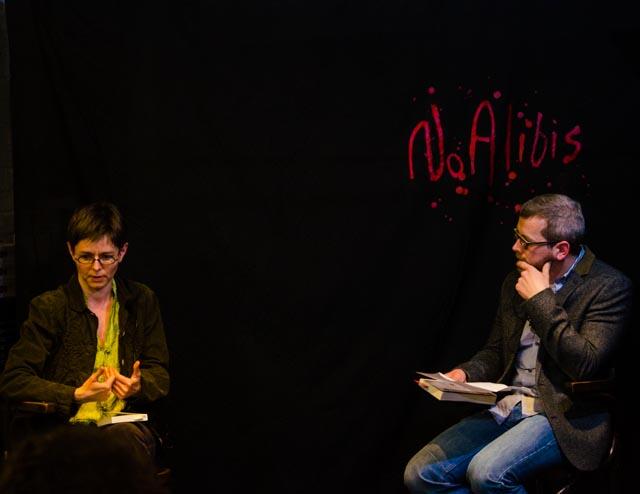
The Writers in the Photo

Photo by David Torrans

As always, a wonderful night at No Alibis. The #QUBLitFest event was very well attended and everybody seemed to have a great time. Plenty of smiles and good vibes. It was a pleasure to chat with Hélène Gestern, first for the benefit of an engaged audience, and then again over dinner at Molly's Yard after the event. Gestern is as intelligent, thought provoking and entertaining as her novel, The People in the Photo. Can't wait for the next Queen's French Literary Festival.

Many thanks to David Torrans of No Alibis for hosting the event and, as always, for his work in promoting the literary scene in Northern Ireland. And to Claudia, who helpfully pointed out that my own books wouldn't sell if I left them on their kitchen countertop in a cardboard box. Also, thank you to Dominique Jeannerod, Amelie Rougeot, Catriona Seth and all the fine people in the School of Modern Languages at QUB for their parts in organising the event, and to all the cool cats who showed up to make it such a fun night. Hat tips to Michael Nolan, Stephen Sexton, Laura Garland, Allen McKay and Andrew Pepper for adding some familiar faces to the crowd.