A short documentary featuring Adrian McKinty. You're welcome.
Tuesday, 27 May 2014

Sunday, 18 May 2014
The Reading I Haven't Written About...
Back in January of this year, I blogged about reading and set my self the task of reading and writing about 100 books this year. I've written about 12 books and we're 5 months into the year. Now, I don't claim to be a genius mathematician (seriously, my brain just doesn't do mental arithmetic any more) but I'm pretty sure that I'm running behind schedule here.
Here's the thing; I've read a bunch of books this year that I haven't gotten around to writing about. Maybe I finished reading a book in bed and woke up the next day with too little time to scribble down some thoughts, put it off for a day or two, then forgot to return to it. Maybe I just had something else I wanted to do right after closing a book, put off writing about it for a day or two and forgot about it... you get the picture already, right?
So, I've read more than 12 books this year. Off the top of my head some of the books I've liked or loved enough to remember without a written record are:
Blue is the Night by Eoin McNamee
Steal Like An Artist by Austin Kleon
The Front Seat Passenger by Pascal Garnier
The Thin Man by Dashiell Hammett
The Hunter by Richard Stark
(I suspect there are a few more books that belong on this list, but they've slipped my mind)
I also reread The Maltese Falcon and a good portion of The Glass Key (both by Hammett) as well as the unfinished first draft of The Thin Man in the Library of America edition of Hammett: Crime Stories and Other Writing. A few short stories here and there (from mammoth collections like Hemingway's First Forty-Nine Stories and the Black Lizard Big Book of Pulps, mostly) and the odd chapter from a bunch of books that I wanted to refresh my memory of.
I'd still be running behind schedule, even if I'd written about the listed books, of course, but I'd be comfortable enough knowing that my summer reading boost would have helped a little. I've delivered this year's PhD work to QUB, and following my differentiation at the end of the month, I get a few months to myself (sort of) to read and write before the new academic year starts. This means I'll be free to read whatever I fancy and I'll probably take a break from the academic texts I've been dipping in and out of (I could list those, but I don't think you'd care).
So, do I write about the listed books in retrospect? I'm not sure I want to. I think I'll have lost some of the enthusiasm that sticks with you for a day or two after reading and that'll come through in my short reviews. Plus, I'm clocking up more titles that should go on the list every week or two. But then, these are all books worth talking about. Also, I've a bunch of fiction writing I want to get done (and reading of the work I've written, as the process goes). Or do I just abandon the whole 100 books thing and simply write what I feel like writing about when I feel like it?
You know what? My son wants me to make his some grub right now. I'll think about this later. If I feel like it.
Currently reading The Friends of Eddie Coyle by George V. Higgins and Plotting and Writing Suspense Fiction by Patricia Highsmith, by the way.
Tuesday, 13 May 2014
Four Writers - On Writing...
There are three writers who have been very kind to me over
the last year. Each of them has helped promote my books and have reviewed a
number of my titles. Without them, my profile would have been noticeably lower.
I really believe that. They’re also pretty good friends with each other, so I
always think of them as a collective; and as friends of mine.
Now, the thing is, due to my lifestyle, I can’t read and
review every book that I’d like to. I barely get the time to read the books
essential to the PhD I’m currently working on. But I had an urge to show these
writers how much I appreciate all they’ve done for me. Best I could come up
with was this lousy four-way interview. But here, I think it turned out all
right. So, without further ado, here’s what happens when Ryan Bracha, KeithNixon, Mark Wilson and I get together via a long-ass web chat.
GB - Keith: You're an
active reviewer on Big Al's Books and Pals and Crime Fiction Lover; what have
you learned from the experience?

KN - The two sites have a different focus - Al's is on self and indie published books, whereas typically (but not exclusively) CFL is on larger, more established authors and publishers.
It's hard to find good writers, I mean really good ones,
skilled in their craft. There's a huge number of books out there, and more
being added every day. Of the self publish stuff I see about 10% are top notch.
The indie published authors have already been in effect
filtered and generally they are of a higher quality - they have a contract for
a reason.
Having a traditional publisher contract doesn't guarantee
the reader is going to pick up any better books, however. I don't suddenly find
a huge step up over at CFL, for instance.
Finally, unless you're a major name like Ian Rankin,
visibility is key.
KN - So Bracha, name
the three best and one worst decision that has meant the most to your success
as an author?

RB - Good question that. The best three decisions... Okay, first and foremost has been the decision to do everything myself. I've learned to create cover art, edit, publish and market it to my own standards, so if any part fails it's on me. If it's a success I get to congratulate myself. Plus it means everything I do is cost free, ensuring maximum return on investment, which goes only to me. Or the wife. Which is nice.
Second one, um, I suppose it lays with my decision to never
revise my work other than for continuity issues or typos. It gives me a chance
to hammer the work out and get promoting it. I reckon I've done well so far, in
that the work has been greatly received and performed far higher than I ever
hoped. The longer it goes on though, the more the expectation that the bubble's
gonna burst with the next book when it turns out to be utter garbage.
The third one is to know when to take advice. I've been
known to think I know it all, but with my writing I'm always happy to learn
from more experienced hands and apply it to my increasing arsenal of skills and
knowledge. It's been a huge case of slowly slowly catchy monkey. I want to make
a real success of myself in the literary arena. The worst decision I made was
to ignore my wife the first ten times she told me to self publish. I could be a
year more experienced if I'd listened to her!
RB - Mr Wilson, your
4 main works of fiction have been 4 vastly different genres, each with various
influences. Which one taught you the most about your art and why?

MW - In all honesty I only began to feel like I was becoming a competent writer by my third book, Head Boy. By the end of it I reckoned I was developing enough to start thinking of myself as a writer. Writing from the mindset of a sadistic sociopath brought me right out of my literary shell.
MW - Question for
Gerry: For a writer who sets his books in Northern Ireland
GB - Most of my Troubles experiences are now blurry
memories. I remember British soldiers who emerged from a graveyard next to our
house in Warrenpoint in the eighties at regular intervals. I remember being
searched by prison guards at Long Kesh prison when I visited family members at
the ripe old age of 6. I remember my mother handing her handbag over to
security guards at the front door of Castlecourt Shopping Centre in Belfast and wondering why
they were allowed to poke around in there when I wasn't. But there's also a
stock-pile of primary and secondary source Troubles stories in my memory banks
from lips lubricated by liquor; mostly from a Republican perspective.
It took a long time to get everything almost straight in my
immature brain. And I'm one of the lucky ones. I was shielded by a lot of the
shite by my father and his decision to raise his family outside of Belfast . I was still
aware of the conflict and the roles that people I knew played in it, but those
aren't my stories. I think if I wrote about the Troubles (and I probably will)
it would be with the intention to explain my own opinions and experiences to my
children, who will have as many questions as I had as they grow up. I just
don't know when will be the best time to do that. I think I need a little more
distance first. Until then, it'll remain peripheral to my work.
GB - Ryan: One of the
things we seem to have in common is a pretty eclectic taste in music, at least
according to the Facebook updates you've written that have caught my eye. Do
you draw on music for inspiration in your writing? And do you listen to music
when you write?
RB - Most definitely, is the answer to your first question.
Music is one of my truest passions, and yeah I do consider my tastes eclectic.
I love that feeling you get when you hear a band or artist for the first time
and you just instantly know that you've found something that's gonna be with
you forever, and then seeing it performed live is another level altogether.
As far as influences go, yeah, I take a fair bit of
influence from artists who stretch themselves, and don't play it safe to compromise
what they're trying to say. Scroobius Pip is one such artist. Or Beck, I love
how he changes direction with every release. I like instrumental music to write
to, because I find myself sidetracked by singing along otherwise! The
soundtrack to Amelie, by Yann Tiersenn is a consistent favourite in the
headphones when I'm tapping away.
RB - Keef! We're all
authors who set our books particularly local to ourselves, as I'm sure most
are, what is it about Margate
KN - Ok several reasons. One is write about what you know. Margate is on my
doorstep. But the biggest factor was the backdrop, ie a once successful town
gone to seed, suited the narrative and characters.
KN - Wilson, you've
produced work across a wide range of genres - memoir to superhero thriller to
crime to dystopian. Are you a restless writer?
MW - Restless is a good way to describe my head, so, yes I
suppose. I'm a bit of a slut to my brain's whims. The business side of my brain
wants to pick a genre and stick to it. The writer part just wants to go with
whatever story is tugging at my literary knickers. I can't sleep until I empty
my head so I just crack on. I don't really think about what genre a particular
book fits into until I'm about half way through the manuscript, then I start
marketing to that genre and the business brain lets out a long fart of released
tension.
In all honesty, despite the obvious benefits of sticking
with a genre or style of writing, I don't think I'll ever be able to stay faithful
to one. I'm quite happy to be a genre-tart.
MW - Bracha: More
than once I've seen comments (and made them) noting your very 'Scottish'
writing style. Even in your books that lack Scottish characters, a very Celtic
humour and tone comes through. Explain yourself.
RB - I dunno mate. Maybe it's the Scots who have a very
Bracha humour and tone? Nah, it's just the way I've always written, I think
I've told this story before, but when I first started writing Strangers, I
would hand out the first few chapters to anybody that would take them, and one
fella who read it handed me a novel saying I'd probably enjoy the writing,
based on my style, and it took me months to finally read it. It was Bedroom
Secrets of the Master Chefs by Irvine Welsh and it blew me away. Superior to mine without
a doubt, but it set me on course for a love affair with Scottish writing that
shows no sign of abating, and has no doubt filtered into my own writing. I
completely associate with the total disregard for convention, the foul mouthed
humour and sometimes inhuman ability to be inventive with the language that the
best Scots have. The short answer, though, is I dunno.
RB - Brennan: If you
were stuck in the Andes with your characters,
which would you eat first? Which would you kill in a fit of fury? And which
would you be happy to chill out and shoot the shit with?
GB - Right; eat, kill, shoot the shit... I'll pick WEE
ROCKETS as the basis for the answer since (judging by sales and reviews) it's
my most popular book. So, I'd probably eat Liam Greene, as he's the meatiest
and he deserves it. Feckin' parasite.
I'd probably kill Joe Phillips in a fit of rage, because
he's pretty gormless and frustrating. He's not a bad lad, really, but I know
how irritable I can get from time to time. Put me on the Andes
with no food, you better not break wind.
And for shooting the shit, it has to be Wee Danny Gibson.
He's the most likely to have remembered to pack a carry out and he's pretty
funny. I should point out, that in my mind, these kids aren't 14 years old
anymore. They're almost 20 now. That makes me a little less creepy, right?
GB - Mark... I
imagine it took a lot of courage to write Paddy's Daddy. Reading the dedication
alone almost broke my heart. How do you feel about your son reading this book
in the future? I ask because I'm playing with a similar idea myself and I'm a
bit scared of it.
MW - Good question Gerry.
I thought about that a lot in the months after I published
the autobiography. Spent a lot of time worrying that my son would be
disappointed when he grew up and realised his da' isn't who he thought he was.
Two things happened to take that worry away. First I realised that every son
gets to a point when they lose their illusions about the hero dad they believe
in, and then they grow up and hopefully reconnect in a different way.
Secondly, I spoke to my wife about it and she pointed out
that I was forgetting who the boy is.
He's only five but is a very self assured, confident,
empathetic and funny as fuck wee dude. Seriously, my five year old is the best
man I know. My Mrs reminded me of that and asked me what I thought Paddy's
reaction would be when he was a grown man and understood the childhood I'd had
and the resulting problems that followed.
Simple answer. He'll be well proud of his old man for
changing his life for his kids.
Problem solved.
KN - Where the fuck
did Fireproof come from? Quite different to your other books - religion, God
and the devil none of which figures elsewhere…
GB – I’m actually surprised that this is the first time I’ve
been asked that question. The answer’s pretty simple, though. FIREPROOF was
published after WEE ROCKETS, but it was actually written before. Back then
(about 2006, I think – other books were written and abandoned back in my
earlier writing days and I didn’t keep date records), I considered myself a
horror writer rather than a crime writer. But then I realised that I was
actually better at writing crime. However, Al Guthrie, once my agent and now my
publisher via Blasted Heath, thought that FIREPROOF was a decent read when I
showed it to him. It needed work, of course, and Al helped me with that. Al’s
input and reassurance made me realise that the book was a lot better than I’d
originally thought.
The next thing was to decide whether or not to release it
under a pseudonym, even an obvious one, like how the late, great Iain Banks put
an ‘M’ in the middle of his name to denote when he’d switched to science
fiction. My middle name happens to begin with an M as well, but I’d have gone
with something a tad more original. However, after some thought, it seemed like
I’d be making work for myself by trying to handle two writing careers side by
side. So I let it come out under my name and waited to see if anybody called me
on it. Two years later, and you’re the first to do that…
But yeah, why a supernatural book that’s heavy on religious
and social piss-taking? It was just good fun to write, to be honest. I’ll
return to that universe some time soon, I hope, because there are readers who
prefer it to my other stuff and I think it’d still be fun to just let my
imagination and mischief run riot again. But I’ve a bunch of crime stuff lined
up first.
RB - (Round-up
question) So the film or TV show of one
of your books has been made, and the opening credits are rolling, I don't care
who made it or who's in it. What's the song that's playing over those credits?
For me, I'm choosing Prodigy, Invaders Must Die for PAUL CARTER IS A DEAD MAN.
Might be a bit obvious but it's frantic enough to cover that opening scene.
GB - I'm going with Thin Line by HoneyHoney to open BREAKING
POINT.
KN - Flyswatter by The Eels for THE FIX.
MW - I'm having Brasco by Hopeless Heroic for dEaDINBURGH.
And there you have it. Enjoy the interview? Why not check
out some of their work, then? They've got Amazon pages and whatnot, like proper pros:
Ryan Bracha Amazon Page
Keith Nixon Amazon Page
Mark Wilson Amazon Page
Ryan Bracha Amazon Page
Keith Nixon Amazon Page
Mark Wilson Amazon Page
Saturday, 3 May 2014
The Writers in the Photo
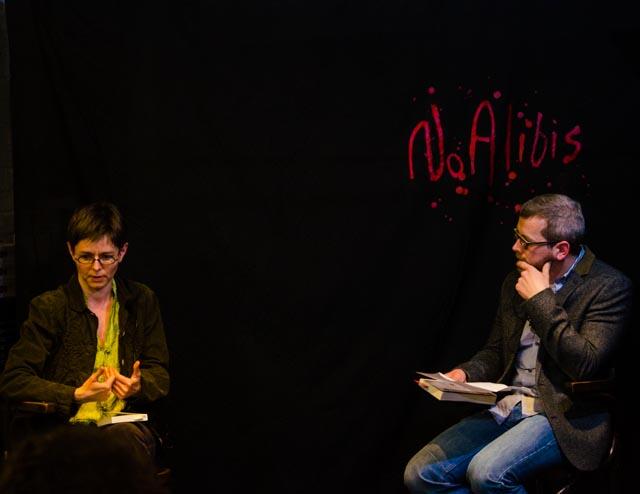 |
| Photo by David Torrans |
As always, a wonderful night at No Alibis. The #QUBLitFest event was very well attended and everybody seemed to have a great time. Plenty of smiles and good vibes. It was a pleasure to chat with Hélène Gestern, first for the benefit of an engaged audience, and then again over dinner at Molly's Yard after the event. Gestern is as intelligent, thought provoking and entertaining as her novel, The People in the Photo. Can't wait for the next Queen's French Literary Festival.
Many thanks to David Torrans of No Alibis for hosting the event and, as always, for his work in promoting the literary scene in Northern Ireland. And to Claudia, who helpfully pointed out that my own books wouldn't sell if I left them on their kitchen countertop in a cardboard box. Also, thank you to Dominique Jeannerod, Amelie Rougeot, Catriona Seth and all the fine people in the School of Modern Languages at QUB for their parts in organising the event, and to all the cool cats who showed up to make it such a fun night. Hat tips to Michael Nolan, Stephen Sexton, Laura Garland, Allen McKay and Andrew Pepper for adding some familiar faces to the crowd.
Thursday, 1 May 2014
The People in the Photo by Hélène Gestern

The People in the Photo is Hélène Gestern's first novel to be published in English. Originally released in France under the title Eux sur la Photo, this is a book that has racked up over 20 literary awards. The English version that I read, published by Gallic Books, sports a quote from La Magazine Littéraire on the front cover; 'A wonderful book about the archaeology of memory'. and that pretty much nails the theme.
In a nutshell, the story starts out with Stéphane Crusten's response to an ad placed by Hélène Hivert who is seeking information about a picture of a woman and two men from a previous generation. It comes to pass that two of the people in the photo are Hélène's mother and Stéphane's father. The twist is that both Hélène and Stéphane's respective parents from the photo are dead, and that Hélène has never met her mother. And so, the mystery plot thickens... The pair continue their correspondence so that the novel becomes an epistolary (it's practically a dialogic or two-way epistolary, except for the introduction of three other POVs towards the end of the book) that builds to an emotional crescendo seamlessly.
This, obviously, is a book that's somewhat outside of the normal scope of this blog, but as a writer, I feel reading outside of your chosen genre can only strengthen your skills. Plus, I'm 'in conversation' with Hélène Gestern tomorrow night (Friday 2nd May at 6.30pm at No Alibis in Belfast), and figured this blog post would make for a nice warm-up.
So, the CSNI verdict? The People in the Photo is an engaging and thought-provoking read that worked incredibly well within the confines of the epistolary form. Gestern puts meat on the bones of the skeletons in her characters’ closets. A masterclass in imagery.
If you want to know more, and you're within travelling distance of Belfast, come to the event! Details can be found here.
Tuesday, 29 April 2014
#mywritingprocess

First off, thanks to Steve Cavanagh for the kind invitation to contribute to this bloggy chain-letter-type thing. Steve is Northern Ireland’s latest crime fiction success story, and if you want to find out more about him, go read his Writing Process blog post, right here. Then read more of his blog posts. They’re always good. You’ll notice that he’s one of those writers who does things the right way. That’s how come he’s got a swanky deal with one of my favourite publishers, Orion. Lucky (hardworking) fecker.
You back from Steve’s gaff yet?
Sound. Here’s my post:
a) What am I working on?
Thanks for asking! Today I finished up
a short story for an anthology I was invited to contribute to. It’s
a noir piece with a bunch of supernatural stuff loosely based on the
Morrigan myth. It would have fit well with the Requiems for the Departed brief, but I chose not to contribute to the Irish myth/crime fiction anthology because I
co-edited the book and that seemed like a liberety.
Other than the short story, I’ve got
a creative writing PhD keeping me busy, for which I must produce a
new and ‘highly original’ crime fiction novel along with a
critical piece on some old school greats. And I’m working on a
Northern Irish police procedural during all those awesome university
holidays.
b) How does my work differ from others
of its genre?
People tell me I have a unique voice,
so I guess I’ve set myself apart stylistically. I’m quite proud
of myself when somebody says that, actually, so it must be important
to me. I set pretty much all of my stuff in Northern Ireland,
though I tend to avoid the Troubles. That’s not to say I
won’t examine the Troubles in the future. In fact, I plan to do just
that. But for now, that’s something else that readers point out as
somewhat original. Also, my work has a noir quality to it. The great
Stuart Neville once described by work as Norn Noir (a play on the
term Norn Iron which is how some of the natives pronounce Northern
Ireland). A shame that many agents and publishers aren’t interested
in the Northern Irish noir sub-genre at the moment, though.
c) Why do I write what I do?
Writing is a long and solitary process.
If I wasn’t spending time with the type of characters I create, I’d
get bored very quickly. In fact, I’d jack writing in if it didn’t
entertain me. So I guess it’s just a case of writing the kind of
stuff I’d like to read.
d) How does your writing process work?
Most of the time it doesn’t work. I
get distracted really easily, unfortunately. However, in those
moments when the writing machine is firing at full tilt, I’ve
found I do my best work in the morning, so long as I’ve prepared a
little the night before. And the preparation doesn't have to be all that time consuming either. If I have a decent outline written, I can read the beats for the chapter or chapters I hope to write the next day. Sometimes I'll add additional notes to clarify the beats or to incorporate a new idea. Then I can get cracking on the actual writing the next morning. This is a relatively new process for me, but it helped me write my latest novella, BREAKING POINT, in less than a month. That's an output record I want to beat in the summer, after I've met my PhD deadlines in May.
There’s a writer called Sean Platt who penned a great blog post that describes a process similar to mine right here. This guy’s output is pretty stunning; he’s much more productive than I am. So read that, and you’ll find out how I’d like my process to work.
There’s a writer called Sean Platt who penned a great blog post that describes a process similar to mine right here. This guy’s output is pretty stunning; he’s much more productive than I am. So read that, and you’ll find out how I’d like my process to work.
Right, so, the three writers that I’d
like to continue this chain-letter-type bloggy thing are:
I met both Michael and Caroline on the
MA in creative writing at QUB a couple of years ago. Their writing
rocks and they’re starting to get the recognition they deserve. I
met Mark McCann at No Alibis and again at Kitty Daly’s pub in
Belfast. Turns out he’s a good friend of a good friend of mine, and
he’s a rather funky author of supernatural noir. What’s not to
like?
Wednesday, 23 April 2014
No Alibis/QUB Event -- Hélène Gestern
 |
| Click image for full-size version. |
I'm currently reading Eux sur la Photo (translated as The People in the Photo for those of us who are linguistically challenged), and so far it's great. Looking forward to the chat, though I hope Hélène Gestern's English is better than my French; or at the very least that my PhD supervisor, Dr Dominique Jeannerod, is willing to act as interpreter. I say this for effect, of course. Dominique will be there. Everything will be grand!
You can get a copy of this excellent epistolary at No Alibis right now. Why not grab one before the event?
Tuesday, 22 April 2014
An Interview - Mark McCann

Mark McCann is a Self Published Author of hard boiled supernatural thrillers and Co-Owner and Senior Editor of Cult Nerd Website Badhaven.com. Star of YouTubes 'The BAD MAN Show' he also contributes feature articles to Bad Haven among other online outlets and news hubs - a habit he formed from his tenure as film critic for local newspapers around his hometown of Belfast.
Q1.
What are you writing at the minute?
I just finished up a few horror shorts for an upcoming Horror/Sci-Fi Anthology called ‘Inside I’m Darkness’ and I’m working on a fairly personal novel based on a lot of my own familial experiences called Return of the Scapegoat Kid.
I just finished up a few horror shorts for an upcoming Horror/Sci-Fi Anthology called ‘Inside I’m Darkness’ and I’m working on a fairly personal novel based on a lot of my own familial experiences called Return of the Scapegoat Kid.
It’s
the tale of two estranged brothers and their awkward, painful, manic
and mostly blackly comic journey towards reconciliation. I’m
billing it as an Irvine Welsh style commentary meets a family drama -
equal parts debauched humour and genuine insight into the
dysfunctional family unit.
Q2. Can you give us an idea of your typical up-to-the-armpits-in-ideas-and-time writing day?
My day is mostly composed of frantically trying to fit everything in. I come home, powernap, drink copious amounts of coffee, put some music on and settle into my chair with my laptop and get started. I usually write down ideas as I have them and always have a mental concept of what I’m going to be writing next.
I
then process those ideas into my loose plot outline until something
coherent emerges at the end. A lot of writers have a much tighter
structure, but I’ve always liked mine loose. I like to surprise
myself with twists that might occur to me as I go, and I find those
surprises translate well for a reader.
I’d
love to pretend I’m more organised and locked down, but truthfully
I’m not. When I get going however, I enter ‘the zone’ and type
like a champ.
Q3. What do you do when you’re not writing?
I work part-time for an online comic book retailer by day and up until the last few months I was editor on cult website Badhaven.com in the evenings until it became consumptive to the point where I needed to take a step back and focus on my writing again.
Q3. What do you do when you’re not writing?
I work part-time for an online comic book retailer by day and up until the last few months I was editor on cult website Badhaven.com in the evenings until it became consumptive to the point where I needed to take a step back and focus on my writing again.
I
train as a power lifter a few nights a week and I read a lot, whether
it be books, articles, graphic novels, comics – the heap. I enjoy
nights out to the cinema and the odd bit of travel, but my favourite
thing is lazy days with my girlfriend in those fleeting moments when
we can just chill out and read together. They are too few.
Q4. Any advice for a greenhorn trying to break into the crime fiction scene?
Work hard, improve your style, take creative criticism well - but don’t listen to small minded or negative people and/or anyone with advice that’s off key.
Q4. Any advice for a greenhorn trying to break into the crime fiction scene?
Work hard, improve your style, take creative criticism well - but don’t listen to small minded or negative people and/or anyone with advice that’s off key.
Trust
your gut, take heart in that nobody ever made it by not trying and
always finish what you start. But most importantly - never, ever
regardless of what anyone tells you or how utterly impractical,
financially difficult or unrealistic it may seem – never ever give
up! It’s your dream. So it’s up to you to live it.
Writing
can be hard, but it’s like Bruce Lee says; don’t
pray for an easy life. Pray for the strength to endure a hard one.
Truer words!
Q5. Which crime writers have impressed you this year?
This year I’ve mostly been back at the classics - re-treading Hammett and Crumley. But as I write crime with a supernatural edge I’ve always enjoyed Mike Carey’s Felix Castor series. He makes me feel so fiercely inadequate about my own writing that the competitor in me is continually driven to improve.
Q6. What are you reading right now?
I just finished Markus Zusak’s The Book Thief and now I’m re-reading Hammett’s The Maltese Falcon along with Peter V Brett’s fantastic fantasy shorts The Great Bazaar and Brayan’s Gold.
Q7. Plans for the future?
Finish my current novel, pitch the anthology and begin the dogged submissions process. And maybe get an artist for a little graphic novel I’m plotting called That Dame’s Unstoppable! But that’s another story.
Q5. Which crime writers have impressed you this year?
This year I’ve mostly been back at the classics - re-treading Hammett and Crumley. But as I write crime with a supernatural edge I’ve always enjoyed Mike Carey’s Felix Castor series. He makes me feel so fiercely inadequate about my own writing that the competitor in me is continually driven to improve.
Q6. What are you reading right now?
I just finished Markus Zusak’s The Book Thief and now I’m re-reading Hammett’s The Maltese Falcon along with Peter V Brett’s fantastic fantasy shorts The Great Bazaar and Brayan’s Gold.
Q7. Plans for the future?
Finish my current novel, pitch the anthology and begin the dogged submissions process. And maybe get an artist for a little graphic novel I’m plotting called That Dame’s Unstoppable! But that’s another story.
Q8. With regards to your writing career to date, would you do anything differently?
I’d network more. Submit more definitely. I have a tendency of wanting to do things NOW! And with the cold mistress of harsh experience as my teacher I’ve learned to be much more patient.
I
always end up doing things the hard way and I have a tendency to jump
before I look. I decided to self-publish all of my books and didn’t
even try for an agent or publisher past the first one, so I think I’d
go back and just be more dogged with submitting the first novel while
working on the others and improving my style.
Q9. Do you fancy sharing your worst writing experience?
I don’t think I’ve really had any awful experiences writing. I know that’s pretty boring, but outside of my experience as a writer I’ve had plenty of unpleasantness to act as a counterweight. I’ve been beaten up, knocked out, threatened with knives/ baseball bats, almost killed by a mugger with a crowbar, followed home by paramilitaries, threatened by paramilitaries, almost had my head run over by a car (in a motorbike accident) and had a chunk bitten out of my back by a highly aggressive Alsatian. Writing by comparison has always been a positive delight.
Q10. Anything you want to say that I haven’t asked you about?
Thank you, Mark 'Bad Man' McCann!
Wednesday, 16 April 2014
Deadfast by Mark McCann

This is a book I've been meaning to read for a very long time. I saw the first few chapters back in 2010. Mark introduced himself at the Requiems for the Departed launch and asked if he could send some of his writing my way. He seemed like a decent bloke and I had a beer buzz on, so I said, "Go for it, mate," or something similar. I read the first chapters in early draft form, offered some advice and left him to it. In the intervening years, Mark McCann has become a force to be reckoned with. He's now best known as the Bad Man, founder of the geek-tastic mega-site Bad Haven, but is also moonlighting as a Norn Iron horror hack, following in the big footsteps that Wayne Simmons has laid out over the last few years. You'll learn more about the Bad Man if and when he agrees to do a Q&A. In the meantime, this post is meant to be about his first novel.
Deadfast appeals most directly to the part of me that penned Fireproof. But I think McCann pushed the premise further than I managed. Read that as, if you liked Fireproof, you'll love Deadfast. It's a supernatural-crime fiction combo set in Belfast as narrated by an 'odd job' man with a penchant for vampire slaying by the name of Terry Fennell. If Joss Whedon were to set a Buffy spin-off in the wee big city of Belfast, he'd be hard-pressed to top Deadfast. In Terry Fennell, McCann invokes the spirit of Dashiell Hammett's Spade, possesses Bateman's Dan Starkey and sets him loose on the undead underbelly of Ulster.
Upon mentioning the Bateman, I feel it necessary to point something out. My keen investigative eye spotted that Deadfast's cover unabashedly imitates those of the latest Bateman books, but that seems fair enough. I don't know for sure, but if McCann isn't a Bateman fan, I'll be very surprised, so I'm counting the similarity as an homage to one of his influences. Of course, the Bateman-esque, smart-alecy black humour that permeates the novel could simply be McCann's default setting.
For the more nitpicky among you (and I lump myself into that category), you should know that this is a self-published title and McCann hasn't quite smoothed out all the rough edges of his writing style, but what I read was a huge improvement on my first introduction to his work. He's working hard at his craft and will only get better. And let me be clear, bar some minor typos and a bunch of missing commas, Deadfast is pretty close to professional level. Close enough for me to recommend it, whatever that may be worth to you.
If you're looking for Northern Irish crime fiction with a supernatural flavour, look no further than Deadfast. And if you like it, guess what... a sequel's already available! Looks like it features The Saint more heavily. I could write another paragraph about why that's exciting, but you could figure it out yourself by reading either novel, I'm sure. Also, as you can plainly see on McCann's Amazon page, a shorter work is available that looks like it spends more time with Mister Malawkus, Fennell's raucous tomcat pal. I'm more of a dog person myself, but I'm likely to give this one a go in the near future anyway.
Tuesday, 1 April 2014
Hurt by Brian McGilloway

Brian McGilloway now writes two different police procedural series. His Inspector Devlin series, set in Lifford, Donegal, launched his career. It seems as if his second series, featuring DS Lucy Black (a PSNI officer operating in Derry), has boosted him to higher echelons. And for good reason.
HURT is the second in the DS Lucy Black series and now that I've read it, I'm counting the days until I can get my hands on part 3.
As much as I love the Ben Devlin books, and am eager to read more from the Gadra Inspector, I think Lucy Black is my favourite of the two. Devlin's uniqueness of character comes from the fact that he's an ordinary man, which in itself is a neat trick, but I identify more fully with the flawed Lucy Black. And her flaws became more apparent in HURT. She has her secrets (the fact that her mother is the current Assistant Chief Constable in the PSNI being one) and she has hang-ups (like how she often feels as if she's not being taken seriously), and she seems more unpredictable than Devlin.
HURT's premise is a dark one. An examination of the type of men that prey on teenage girls with self-esteem problems. And then there's the continuation of the major plot point laid out at the end of LITTLE GIRL LOST, which is far from resolved by the end of HURT, but is looking good for some development in part 3. Dammit, when is part 3 out?
Get yourself on the McGilloway wagon right now, people. Though I've a feeling that I might be preaching to the converted. Two great developments in the Derry scribe's career certainly suggest that he's far from operating in obscurity. In recent weeks McGilloway has landed the Tony Doyle Award for screenwriting and LITTLE GIRL LOST has stormed the New York Times Bestseller list. And CSNI congratulates him.
Keep 'er lit, Brian.
Subscribe to:
Posts (Atom)